10 Jul, 2026
Drupal for Government & Public Sector Websites: Security, Accessibility & Scalability


Citizens expect a government website to work as smoothly as their banking app. That's now the baseline for every public sector digital service. So the real question agencies face isn't "do we need a redesign?"; it's "what is the best way to build a government website that's secure, accessible, and ready for the next traffic spike?"
For a growing number of federal, state, and municipal bodies, the answer is Drupal. Not because it's trendy, but because of what it can actually handle. In the following points, we’ll break down why Drupal for Government Websites remains one of the top choices, how it meets compliance and scale requirements, and how agencies can get the most from it.
Why Choosing Drupal for Government Websites Makes Sense?
A basic CMS can publish a page, but it might not be able to withstand a cyberattack, serve a screen-reader user, handle an election-night traffic surge, and keep ten departments aligned at the same time. Government website development needs a platform engineered for risk, scale, and governance, not just content publishing. And Drupal has become the most preferred choice of enterprises for these exact reasons.
Running a government digital team means managing all of this together:
- Targeted attacks on government systems go after sensitive data and uptime
- Section 508, WCAG, and state accessibility laws aren't guidelines; they carry real legal consequences
- Rising pressure to deliver more digital services, from permit applications to enrollment
- A single site serves residents, contractors, employees, and visitors, each on different devices
- Traffic holds steady until an election, emergency, or announcement hits
- Content lives across departments where each team needs control but can't compromise shared governance
Key takeaway: a government website is critical public infrastructure. It has to be treated that way from the architecture stage onward. It has to be treated that way from the architecture stage onward.
How Does Drupal Address the Core Needs of Government Websites?
Over twenty years, Drupal matured into a highly secure, accessible, and scalable open-source CMS built for complex enterprise demands. That maturity, built through continuous community investment and real-world deployment, is exactly what makes Drupal public sector websites successful.
What Makes Drupal's Security Enterprise-Grade?
Drupal's security posture is built around a dedicated, community-led Security Team that reviews security issues affecting Drupal core and contributed projects covered by the security advisory policy, coordinates responsible disclosure, and issues structured advisories, making it a secure government CMS offering clear, actionable information for every patch cycle.
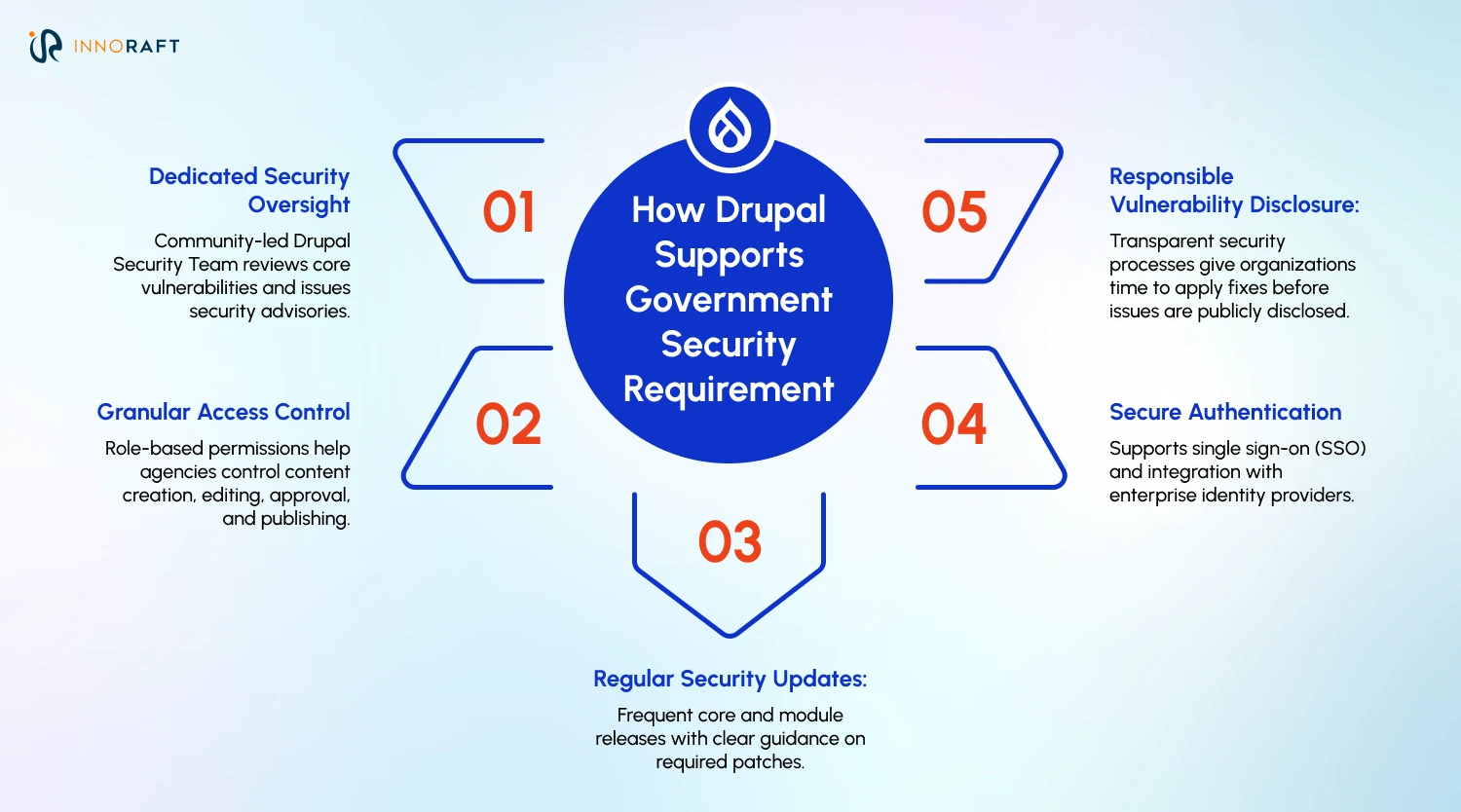
This is also why Drupal development services expertise continues to be one of the most sought after services by government agencies around the world; security-conscious organizations don't choose platforms casually.
Worth being clear on scope: Government websites need to align with various security certifications that vary with location. Drupal for government websites does not provide these certifications itself, but it can be deployed within architectures designed to support them.
Why Is Drupal The Right Choice For Accessible Websites?
From day one, this system supplies the necessary framework for hitting those tough WCAG and Section 508 targets. Still, truly accessible government websites always hinges on the careful choices your staff makes while drafting and uploading their routine digital material.
More than one billion people worldwide live with some form of disability, making accessibility a fundamental aspect of inclusive digital experiences. Governments, public institutions, and organizations across the globe are increasingly required, or expected, to ensure that their digital services are accessible to everyone. While specific legal requirements vary by region, many accessibility regulations and policies are built around the Web Content Accessibility Guidelines (WCAG), which have become the internationally recognized standard for creating accessible websites and applications. Although WCAG 2.0 Level AA remains the legal baseline in some jurisdictions, many organizations are adopting WCAG 2.1 and 2.2 to address modern web technologies and provide a more inclusive experience for users with diverse abilities.
Drupal accessibility compliance supports this with:
- Semantic HTML and ARIA landmarks built into core themes
- Extensive keyboard navigation support across administrative and front-end experiences
- Screen reader compatibility tested against assistive technology
- Accessible form elements, error messaging, and alt-text fields built into the content authoring workflow
- A CKEditor toolset that nudges authors toward accessible formatting (proper headings, table structure, link text)
Pro tip: Accessibility is a process, not a one-time fix. Even a perfectly coded Drupal theme fails WCAG if content editors upload images without alt text or build tables without headers. That is why our experts at Innoraft emphasize the importance of editorial training as much as platform configuration.
How Does Drupal Scale for High-Traffic Public Services?
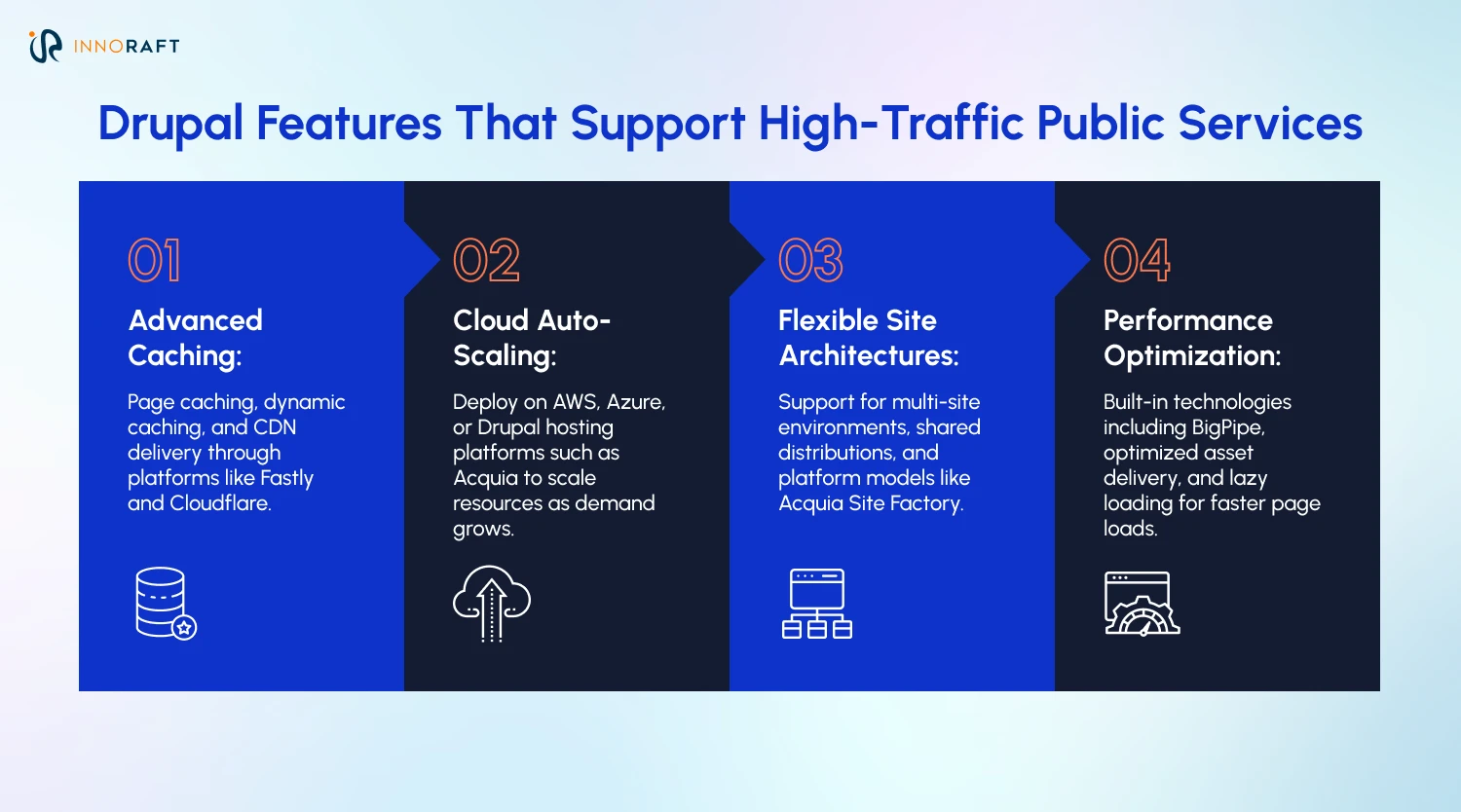
Drupal public sector websites handle traffic surges through built-in caching, integration with CDN and cloud infrastructure, and a modular architecture that lets agencies scale specific services without rebuilding the whole site.
Think about what happens to a state unemployment portal during a sudden economic shock, or a county emergency-alert page during a hurricane. Traffic doesn't grow gradually. It spikes by orders of magnitude in hours.
Key Drupal capabilities that support high-traffic public services are illustrated below:
One real-world success story is the official Rhode Island portal (RI.gov) transitioned from a disjointed collection of static agency pages into a single, cohesive Drupal system, empowering regional departments to manage their own content without frustrating IT delays. The initial hurdle, isolated websites lacking centralized oversight, represents the precise challenge these flexible network strategies were designed to eliminate completely.
How Does Drupal for Government Websites Simplify Massive Multilingual Capabilities?
Native translation tools mean city agencies can instantly post news in twenty languages while running scattered local pages from one single desk, locking down brand standards and keeping total control.
- When supporting culturally diverse civic groups, multilingual, scalable government digital platforms delivers:
- Out-of-the-box, module-free language conversion for articles, settings, and backend menus
- Complete freedom to display information across various dialects using one central repository
- Consolidated oversight covering statewide, local, and departmental pages, ensuring tech teams manage just one system
- Unified visual templates that ensure complete brand consistency while still empowering local teams with editorial control.
How Can Drupal Guarantee Reliable Content Oversight And Accountability?
The native publishing workflows, moderation pipelines, and versioning tools empower public offices with precise authority regarding who drafts, evaluates, clears, and releases materials, alongside a permanent log of all historical edits.
This remains Drupal's most powerful, frequently overlooked advantage for civic institutions. Public departments operate within realities where transparent tracking and absolute responsibility are binding legal mandates, not choices. As a secure government CMS, Drupal addresses this with:
- Content Moderation module for configurable editorial states, draft, needs review, approved, published, mapped to department-specific workflows
- Granular role-based publishing controls so a department editor can write content without ever having the ability to push it live without an approver
- Full revision history on every piece of content, with timestamps and author attribution, so agencies can see exactly what changed and when
- Rollback capability, allowing teams to restore a previous version of any page if an error is published, an essential safeguard when public-facing content errors carry real reputational and legal risk
What Integrations Does Drupal Offer for Connected Government Services?
Drupal's open architecture and large module ecosystem let it connect to nearly any third-party system a government agency relies on, reducing the need for custom-built integrations.
Frequent backend connections for government website development feature:
- Authentication frameworks (Login.gov, Azure AD, SAML/SSO architectures)
- Financial processors handling permits, licenses, penalties, and dues
- Spatial mapping tools displaying civic resources and infrastructure
- Constituent relationship software tracking public casework
- Public information portals sharing statistics through universally accessible frameworks
- External application interfaces fetching daily updates like weather or transit
Where Exactly Do Civic Institutions Deploy Drupal Platforms?
Scalable government digital platforms leverage Drupal whenever civic groups must handle intricate publications, support varied demographic segments, and satisfy rigorous regulations, spanning massive federal gateways down toward isolated agency microsites.
Routine applications feature:
- Federal civic gateways consolidating public assistance, announcements, and legislative documents
- Regional or city networks governing numerous distinct agencies within single centralized frameworks
- Resident self-help gateways processing taxation, welfare, certifications, and approvals
- Accessible information hubs releasing civic metrics to guarantee accountability
- Civic medical platforms requiring rapid capacity expansion amidst pandemics or sudden localized crises
- Academic and scientific domains organizing dense, highly varied publications
- Critical alert centers requiring uninterrupted stability and rapid speeds throughout disasters
How Do You Create a Resilient, Forward-Looking Public Sector Website?
Whether building from scratch or migrating to Drupal, sustainable public websites depend on inclusive design foundations, rigorous publishing oversight, and continuous protection and speed optimization, rather than a solitary launch followed by total abandonment.
Here’s an exclusive look at the practical checklist for government website development Innoraft’s Drupal experts follow:
- [ ] Adopt accessibility-first design from wireframes onward, not as a post-launch audit
- [ ] Establish clear content governance and editorial workflows across departments
- [ ] Keep Drupal core and contributed modules updated on a regular patch cycle
- [ ] Monitor security proactively with automated scanning and the Drupal Security Team's advisories
- [ ] Optimize performance continuously, caching, image compression, code audits
- [ ] Plan for scalability from day one, not after the first traffic crash
- [ ] Conduct regular accessibility and security audits, including manual assistive-technology testing
- [ ] Use analytics to understand and improve the citizen experience over time
This is also where the right implementation partner matters. Agencies that work with Drupal specialists experienced in public sector compliance, which has built government and education platforms, like a custom Drupal 10-backed platform supporting transparent, multilingual admissions under the Right to Education Act tend.
Why Is Drupal a Long-Term Investment for the Public Sector?
Drupal for Government Websites offers lower total cost of ownership, freedom from vendor lock-in, and an architecture that's already adapting to headless, API-first, and AI-driven use cases, all of which matter for budgets that have to justify decisions for years, not quarters.
For decision-makers evaluating platforms against a 5–10 year horizon, Drupal offers:
- Open-source flexibility with no licensing fees tied to user counts or page views
- Reduced licensing costs and vendor independence, Drupal can lower total ownership costs significantly, though implementation, hosting, maintenance, and governance still require real investment; the savings depend heavily on how the platform is managed over time
- A large global community continuously contributing modules, security patches, and improvements
- Future-ready architecture, including headless and decoupled Drupal setups that separate content from presentation for use across websites, apps, and emerging AI-driven interfaces
How Should Agencies Decide If Drupal Is the Right Fit?
If a government website needs to balance strict security, legal accessibility obligations, multi-department governance, and unpredictable scale, all at once, Drupal is particularly well suited for that combination of requirements, with a track record in public sector scalable government digital platforms that few open-source platforms can match.
Government websites are now critical service infrastructure, citizens depend on them for everything from emergency alerts to benefits applications. Drupal for government websites provides civic institutions a foundation that prioritizes protection, inclusivity, and massive growth natively, whilst remaining agile enough to pivot whenever everyday digital demands inevitably increase.
Departments considering an extensive system transfer or overhaul need not tackle regulatory, speed, and backend connection hurdles entirely unsupported. Collaborating with dedicated Drupal development service experts, who bring direct civic and municipal deployment backgrounds, significantly accelerates that journey toward a functional, approved system.
Want to know more about how Drupal is perfect for government websites? Contact us and get the ball rolling on your project!
FAQ
Frequently Asked Questions
Didn’t find what you were looking for here?