24 Jun, 2026
Why Enterprises Choose Drupal for Scalable Digital Platforms | Enterprise CMS Guide


There's a quiet irony at the heart of enterprise technology. The platforms easiest to get started with are always difficult to scale, and the ones that scale are rarely the ones your team finds intuitive from day one. Often, organizations discover this after they have already built their digital infrastructure on a system that starts cracking under real growth.
That shift in thinking, from convenient CMS to foundational digital engine, is exactly why global business leaders keep landing on Drupal for Enterprise Websites. Not because it promises to be the simplest option on the market, but because it promises to handle whatever comes next.
At Innoraft, we often see this play out with clients who have outgrown their existing platforms. The conversation almost always leads back to one question: Does your digital infrastructure have the architectural depth to support where your business is actually going?
Why do Businesses Keep Choosing Drupal for Enterprise Websites?
There have been many comparisons between CMS platforms like Drupal vs WordPress vs AEM. However, Drupal Enterprise CMS earns a top place on enterprise shortlists because of its security posture, scalability, and multisite governance capabilities that become increasingly important as organizations grow in complexity. When the stakes are high and the traffic is real, these stop being bonus features; they become the baseline.
How does Drupal Handle Security for High-Risk Enterprise Environments?
Behind the scenes, Drupal for Enterprises runs an intense security squad handling risk mitigation, rapid-response alerts, and system-wide patches. They rarely wait around for breaches to happen. Instead of waiting, this team finds and fixes vulnerabilities before bad actors do, releasing patches on a strict schedule. Version 11 includes improved tools for background updates and package management.
Built on Symfony 7, the system features strict session controls, secure cookies, and highly granular access rules for every single registered user. Need high-end logins with multi-factor protection? The massive plugin network handles that perfectly.
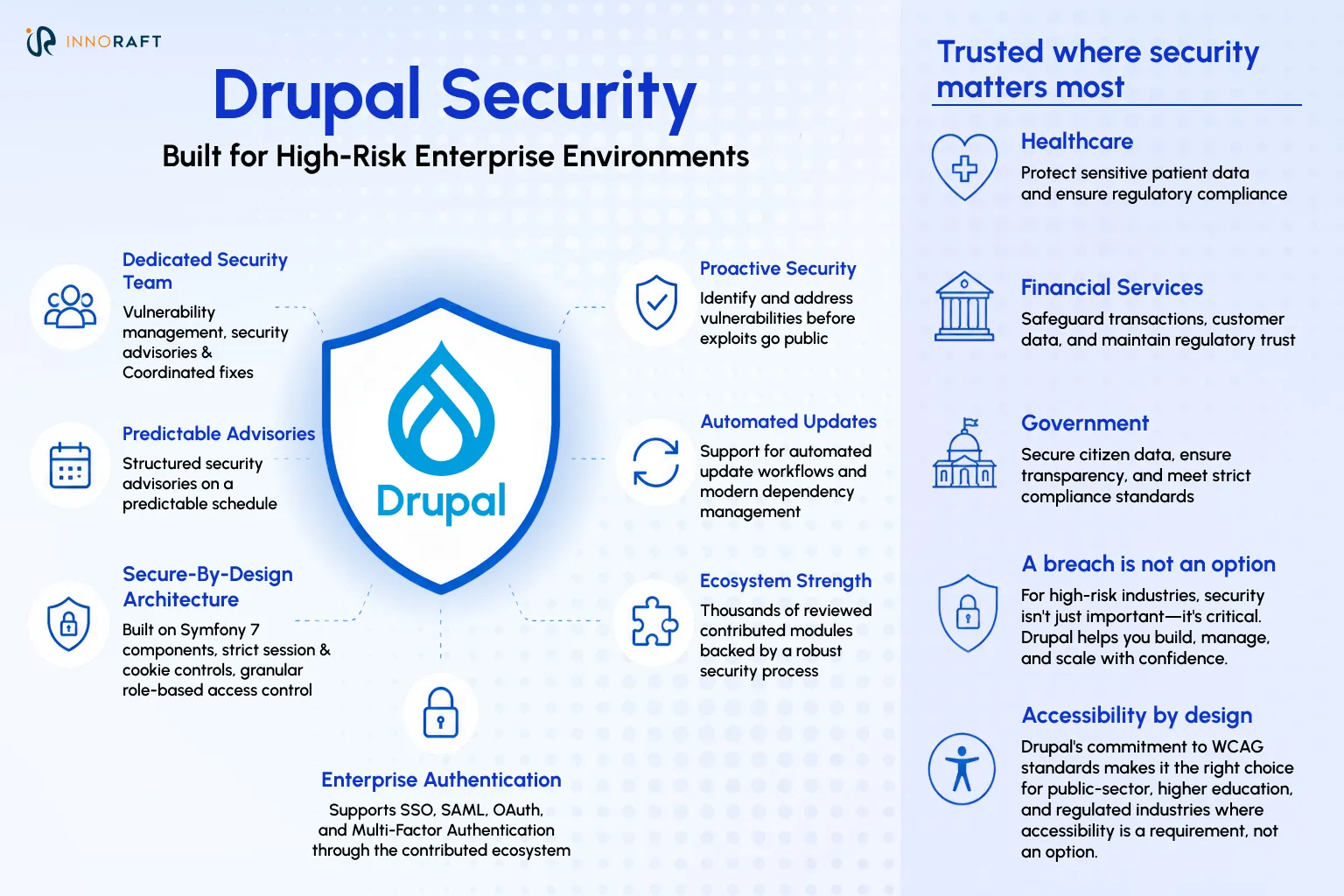
For industries like healthcare, financial services, and government, a single breach can cost more than any licensing fee ever saved. This is not a marginal benefit. It is the deciding factor.
Furthermore, scalable digital platforms like Drupal take accessibility incredibly seriously. This strict dedication to core WCAG guidelines makes the platform an absolute must-have for government sites, universities, or any heavily regulated corporate digital space moving forward today.
What Makes it Easy to Scale with Drupal?
Wondering how Drupal Digital Experience Platform scales so effortlessly? Look straight at version 11, which excels in busy enterprise setups. You gain wildly effective caching protocols, smarter tag handling, and seamless alignment with modern PHP speed boosts. That raw power is absolutely necessary when juggling thousands of simultaneous active users around the globe.
The platform also integrates cleanly with Redis object caching and CDN infrastructure. That matters when a product launch or breaking news event sends traffic surging in minutes. Even small increases in page load time can negatively affect user engagement and conversion rates, a reality enterprises can't really afford to ignore.
How does Drupal Help Manage Multiple Sites Without Losing Governance?
For businesses running multiple sites, Drupal Digital Experience Platform is the most efficient way to run large networks of websites from a single, unified central codebase. From this central hub, you can rapidly deploy critical safety patches, compliance changes, and brand-new designs across the board, while local teams retain absolute control over their own localized content.
Ultimately, major companies keep branding sharp and unified without sparking messy battles between corporate IT and scattered marketing crews.
How does Drupal Support Global Content Operations?
Major brands with global presence are able to easily handle difficult language translations, specific regional variations, custom editorial workflows and strict local supervision, all with Drupal enterprise CMS. When massive brands operate globally, this native setup heavily cuts down wasted busywork. It actively keeps both brand identity and legal compliance totally intact everywhere.
This is one of the major selling points of enterprise Drupal development; deep multilingual capability lives right inside the core system. You gain complete control over foreign text without buying pricey add-ons.
How does Drupal Fit Into a Modern Composable Technology Stack?
Drupal for enterprise websites has moved well beyond the traditional CMS role. It now functions as a content hub inside a composable Digital Experience Platform (DXP), pulling structured data from ERPs and CRMs while pushing content to mobile apps, smart devices, digital kiosks, and external portals, all through a unified API layer.
What does an API-First Content Hub Actually Look Like in Practice?
Going "headless" essentially means you run Drupal digital experience platform strictly behind the scenes to handle core content, letting slick modern frameworks like React, Vue, Angular, or Next.js drive the visual experience. Instead of Drupal rendering pages, it exposes all content through APIs (JSON:API, GraphQL, or REST), enabling consistent delivery across websites, apps, kiosks, smart devices, and platforms that do not yet exist.
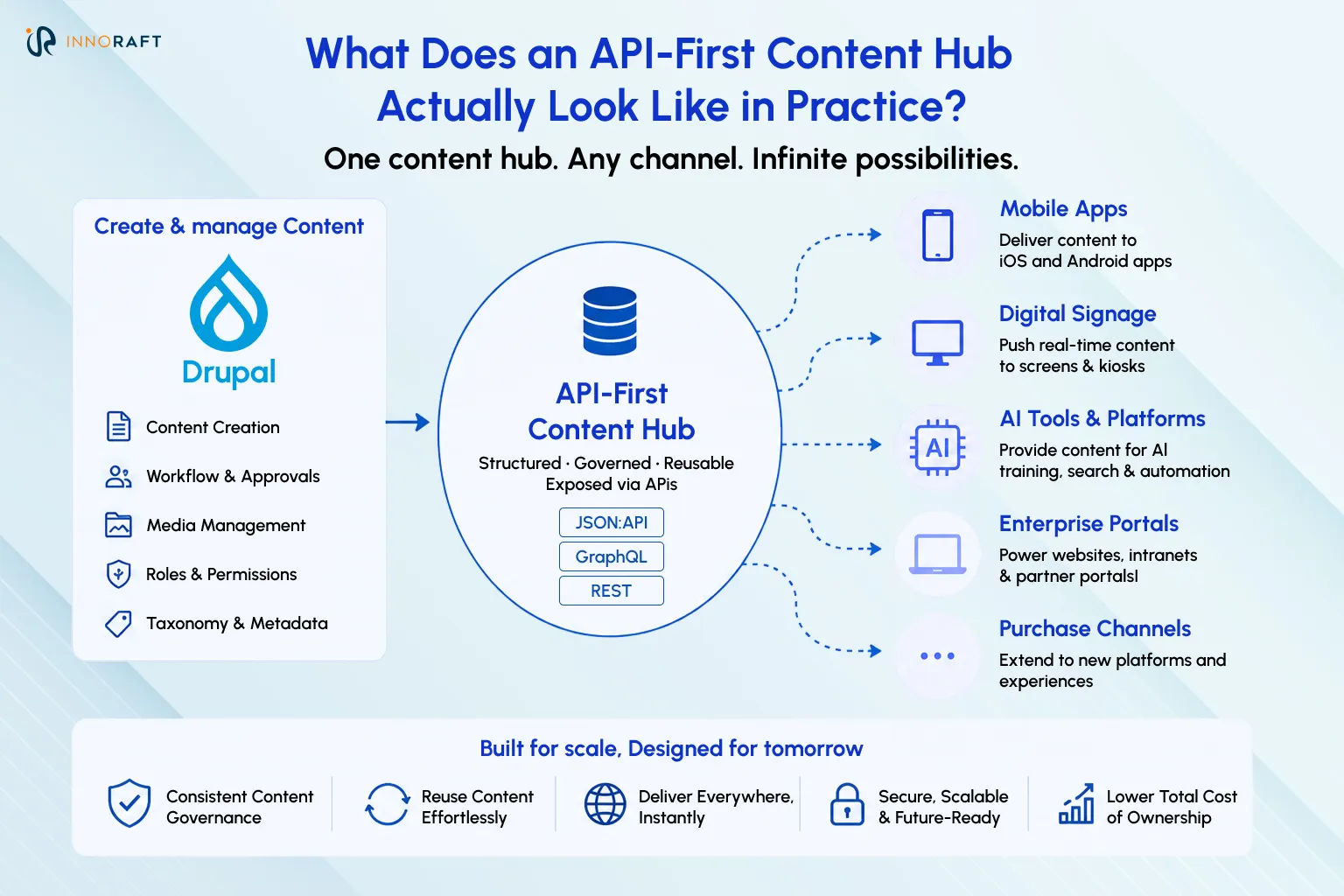
Transit organizations, for example, have used Drupal for Enterprises to power large-scale digital signage networks, pushing real-time content across hundreds of locations from a single governed content layer. That is omnichannel content delivery at operational scale, with no manual duplication.
This is what composable architecture actually means at the enterprise level. Not just separating the front end from the back end, but designing a content structure that can feed any downstream system, today's or tomorrow's.
How is Drupal Integrating AI Into the Editorial Workflow?
Drupal has launched an official AI initiative built on the open-source community, aimed at incorporating AI directly into the CMS while maintaining responsible innovation at the core. The growing Drupal AI ecosystem includes tools that can assist with authoring, suggest metadata automatically, flag content gaps, and surface personalization recommendations based on user behavior, without requiring editorial teams to understand machine learning.
The data privacy advantage of Drupal for enterprise websites is also significant here. Because Drupal is open-source, enterprises retain greater visibility and control over how AI integrations are implemented and governed, rather than depending entirely on a vendor's opaque processing pipeline.
Why does Structured Content Modeling Matter More Than Ever?
Because AI needs clean, structured data to function, and Drupal's taxonomy system, content types, and entity architecture produce well-defined, machine-readable content that AI agents and external applications can actually work with.
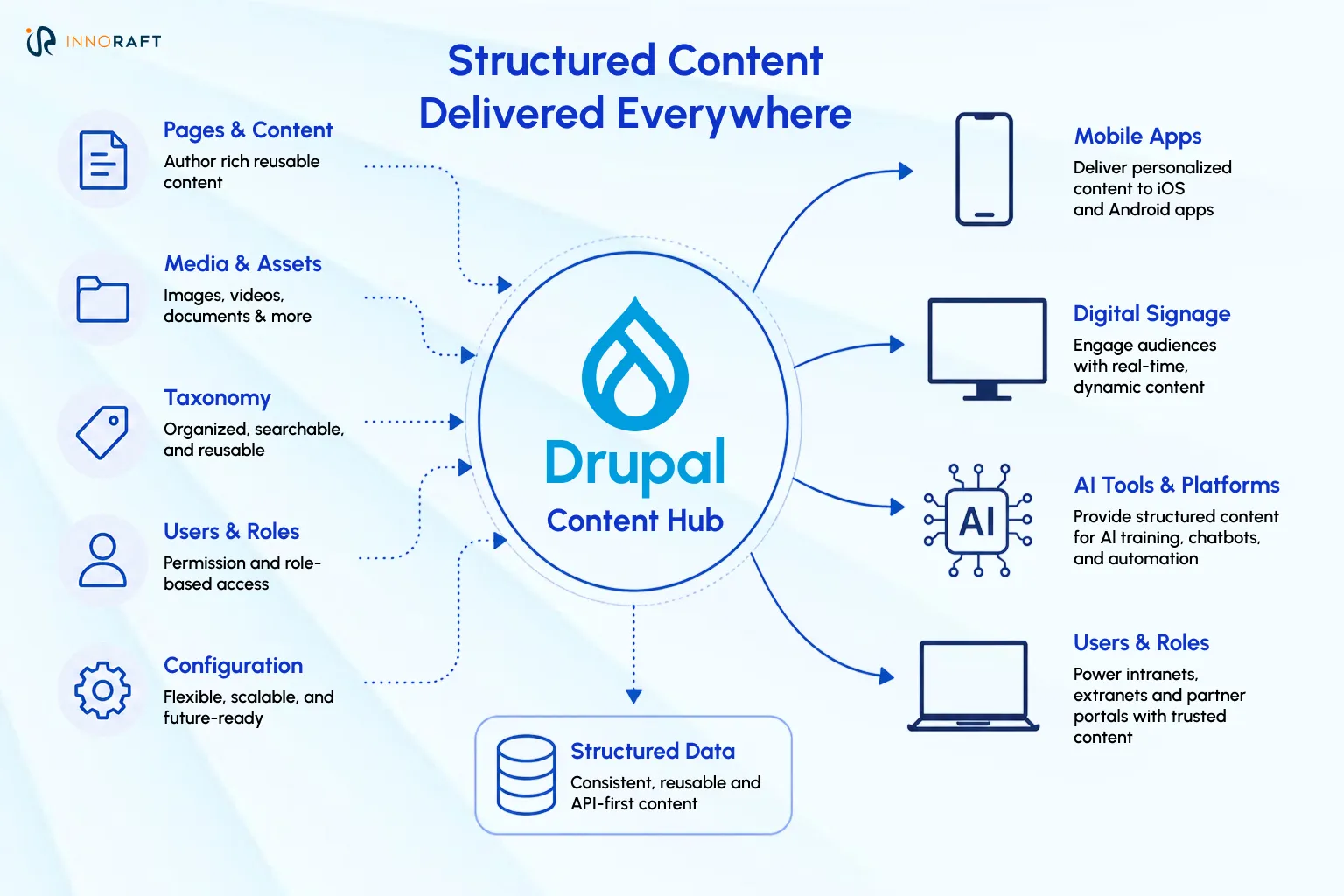
This becomes a competitive advantage when enterprises begin deploying AI-powered search, recommendation engines, or automated content workflows while leveraging enterprise Drupal development. Loosely formatted HTML does not feed a model well. Structured Drupal content does.
How does Drupal Empower Marketing Teams and Developers at the Same Time?
Drupal for enterprises bridges the gap between the people who create content and the people who build the infrastructure, which is exactly where most enterprise platforms quietly fail. Marketers get low-code tools that let them work independently. Developers get modern standards and agile workflows. Neither team is constantly waiting on the other.
What Tools does Drupal Give Marketers to End the IT Bottleneck?
One of the most persistent frustrations inside large organizations is the content update queue, a backlog of marketing tasks that are technically simple but require developer intervention to execute. Layout Builder, Media Library, and content moderation workflows of Drupal Enterprise CMS are specifically designed to clear that queue.
Granular role permissions mean a regional marketing manager can publish localized content without ever touching a codebase. A legal team can review and approve content before it goes live, without needing a separate workflow tool bolted on. Content governance and publishing speed no longer have to be in conflict.
How do Developers Benefit from Drupal's Modern Technical Standards?
Drupal for enterprise websites sits squarely within the modern PHP ecosystem, PHP, Symfony, Twig, and Composer, which is the toolchain experienced developers actually want to work in. Configuration management, CI/CD pipeline integration, and environment-specific deployments allow agile teams to iterate quickly without risking production stability.
When the platform is built on industry-standard tooling rather than proprietary abstractions, the organization is never dependent on a single vendor to maintain, extend, or eventually migrate the system. That is a meaningful architectural advantage over time.
What does Change Management Look Like When Adopting Enterprise Drupal?
Adopting Drupal for Enterprises at scale is not just a technical migration. It is an organizational one. Teams need time to build fluency with Drupal's content modeling approach. Editorial workflows need to be designed, not just configured. Governance decisions need stakeholder alignment before a single line of code gets written.
As an expert Drupal services agency, our experts at Innoraft, the implementations that go smoothly are the ones where the engagement started with architecture planning and organizational readiness, not just platform selection. Skipping that step is where enterprise Drupal development projects run into trouble, not because the platform fails, but because the organization was not prepared to use it.
What does ROI and Total Cost of Ownership Actually Look Like for Enterprise Drupal?
Drupal Digital Experience Platform is open-source, meaning zero licensing fees, but the true investment lies in architecture and specialized development. The long-term value comes from avoiding vendor lock-in, consolidating redundant platforms across departments, and building on a foundation with no expiry date.
How to Think About Total Cost of Ownership: Drupal vs Proprietary CMS | ||
| Cost factor | Proprietary CMS | Drupal (Open Source) |
| Licensing Fees | High (Annual) | None |
| Upfront Build Cost | Moderate-high | High |
| Vendor Lock-in Risk | High | Low |
| Integration Flexibility | Limited | Extensive (large contributed module ecosystem) |
| Long-term Extensibility | Vendor roadmap dependent | Community-driven, ongoing |
| Security Patching | Vendor-Controlled | Proactive, community-audited |
| Multisite Management | Costly add-on | Native, support and mature ecosystem tooling |
| AI Readiness | Proprietary tools only | Open, customizable integration |
However, it is important to note that open-source is not "free." The investment is real, and it lives in qualified Drupal architects, proper hosting infrastructure, and a realistic maintenance budget. Enterprise Drupal development projects require higher upfront investment precisely because enterprises use them to do more, not because the platform is inefficient.
Why does the Long-Term Value Justify the Upfront Investment?
Consider what a large enterprise actually spends maintaining separate CMSs for corporate communications, regional microsites, campaign landing pages, and internal portals. Each platform carries its own licensing fees, integration overhead, security patching cycles, and training requirements. A well-architected Drupal deployment consolidates that sprawl into a single governed ecosystem.
Large consumer brands managing dozens of regional and product-line sites have used the multisite and component-based architecture of Drupal Enterprise CMS to cut redundant development work and launch new brand sites significantly faster than building each one from scratch. That kind of operational efficiency compounds over time, reducing the total cost of maintaining a global digital presence while increasing the speed at which new digital experiences can be launched.
Organizations including Johnson & Johnson, Bayer, Tesla, Pfizer, and Charles Schwab have all built on Drupal digital experience platform at various points in their digital evolution, a pattern that reflects deliberate, sustained investment rather than accidental adoption.
The Bottom Line: Should Every Enterprise Choose Drupal?
Not really. Drupal for enterprises is the right platform for organizations that need sophisticated content governance, complex integration architectures, multilingual delivery at global scale, and a system designed to outlast the next three product refresh cycles. It was never intended to be the fastest path to a basic marketing website, and treating it as one is a setup for frustration.
For enterprises that have outgrown a simpler CMS, or that are building something ambitious enough to need real architectural depth from the start, Drupal remains one of the most extensible and enterprise-proven open-source options available today.
At Innoraft, we help enterprises evaluate whether their current MarTech stack can support where they are actually heading, and we architect Drupal for enterprise websites and solutions for organizations that need to move past what they have. If your business is approaching that inflection point, an enterprise architecture audit is the most valuable first conversation you can have.
Ready to find out whether your current platform can carry your next phase of growth? Contact our experts and discover where your digital infrastructure is quietly holding you back.
FAQ
Frequently Asked Questions
Didn’t find what you were looking for here?