4 Dec, 2024
Drupal vs WordPress vs AEM: Which CMS is Better for Enterprise Websites?

When it comes to choosing a CMS, enterprise decision-makers are asking harder questions: Which platform can handle governance at scale? Which one is truly cloud-native? Which one will not become a security liability in a regulated industry?
At Innoraft, we help enterprises navigate exactly these decisions. The three platforms that come up most in those conversations are Drupal vs WordPress vs AEM. Each has earned its place in the market for very different reasons, and understanding those differences is what this guide is about.
Here is what the data says upfront: WordPress holds around 43% of all websites on the internet and roughly 59.3% of the CMS market. Drupal powers approximately 1.1% of the overall CMS market, yet accounts for 7.2% of the world's top 10,000 highest-traffic websites. That gap tells the real story. Over time, Drupal evolved into one of the best CMS for enterprise websites, widely adopted by enterprises requiring complex content modeling and governance, and that is where it continues to thrive.
Drupal vs WordPress vs AEM: Platform Leaders at a Glance
Uninformed decisions can only hurt your business. This is why, before beginning an enterprise CMS comparison, you must examine the strengths, weaknesses, and unique benefits of each CMS under consideration.
Let us examine the same for Drupal, AEM, and WordPress before we check whether they are aligned with modern enterprise CMS requirements.
What You Need to Know About Drupal?
Drupal is a free, open-source enterprise Content Management System built for complex digital experiences. It is supported by a large community of developers, testers, coordinators, strategists, designers, editors, and sponsors. Its core strengths lie in structured content architecture, enterprise governance, and long-term scalability.
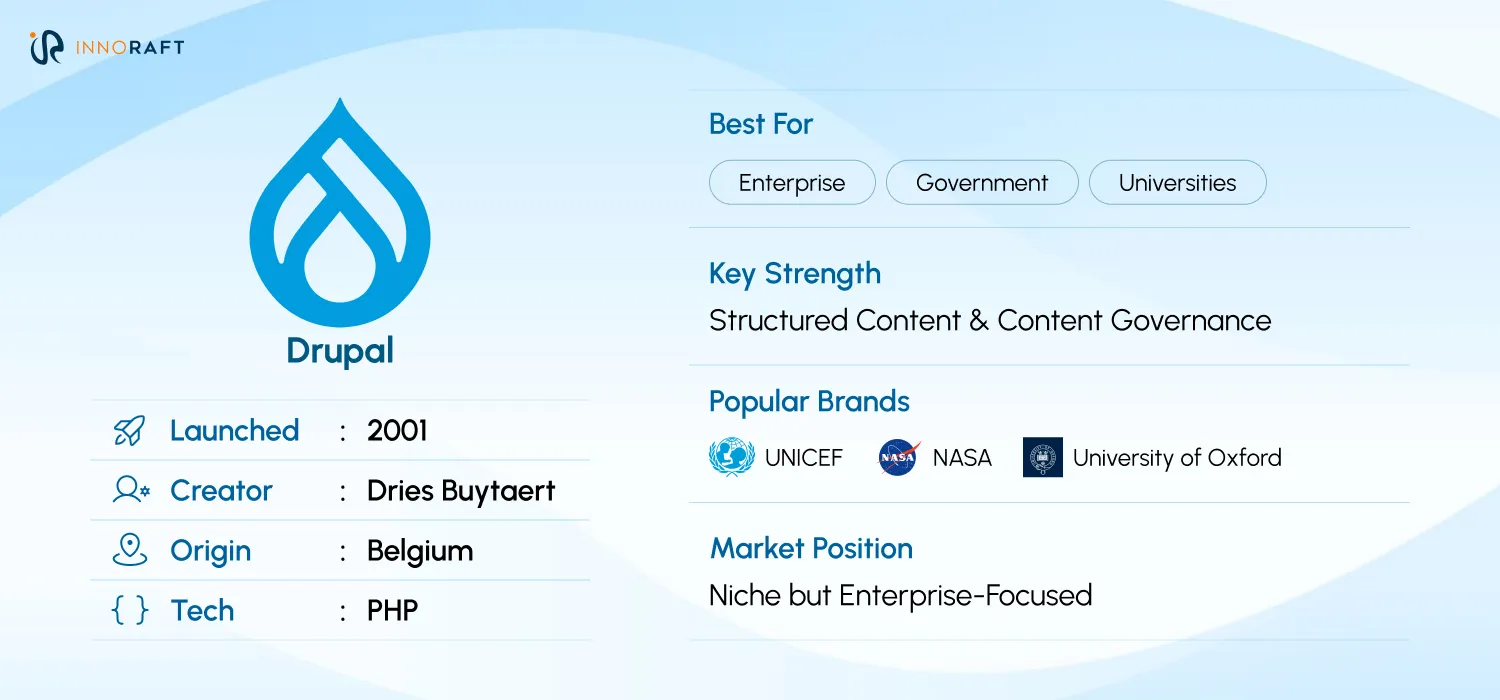
As a CMS, Drupal provides a user interface that allows you to create and publish your content easily. The platform accommodates unlimited content types, including text and media content with highly customizable forms. All the administrative and end-user-facing functionality in Drupal, from fundamental features such as the ability to log in or create content to dynamic photo galleries and complex voting systems, comes from modules. Moreover, Drupal cms services also expand to a robust web development platform, powering websites like Tesla, Oxford University, the US government’s Weather.gov, and hundreds of other higher-education institutions worldwide.
Everything You Need to Know About WordPress
WordPress, another open-source giant, remains the planet's most popular CMS in any enterprise CMS comparison discussion. Born simply as a blogging tool back in 2003, it quickly evolved into a massive, free content management engine that is driving a majority of websites on the internet.
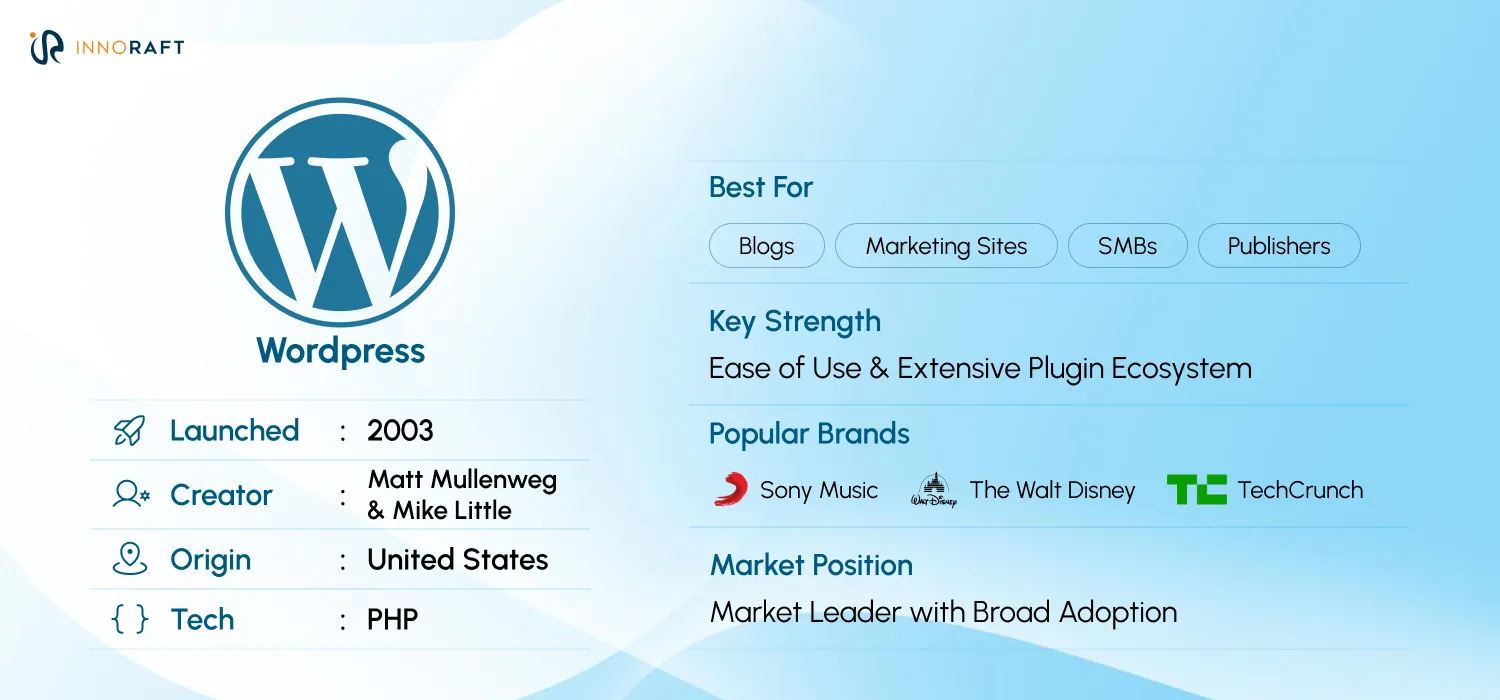
People use it to launch and grow absolutely any kind of online platform, from tiny hobbyist blogs up to massive corporate hubs for The New York Times or Sony Music. Its real magic comes from matching raw flexibility with an incredible ecosystem boasting over 60,000 plugins alongside countless skilled developers. Plus, the core dashboard stays remarkably intuitive, letting everyday folks run complex things without ever needing expensive coding degrees. Packed neatly under the GNU GPLv2 license, getting this powerful software installed really takes just minutes; simply grab some solid web hosting, and you are completely ready.
What You Need to Know About AEM?
You can consider Adobe Experience Manager as the heavyweight champion of Enterprise Content Management System (CMS) platforms. As part of the broader Adobe Experience Cloud, AEM seamlessly blends robust content management with digital asset management. Add Adobe Sensei for smart, AI-driven personalization, plus tight Creative Cloud ties, and you get a powerhouse. Frankly, it targets massive global brands holding the technical chops and budgets to unlock its potential. From one cloud-native hub, teams can confidently push tailored content across countless channels. Whether you need a traditional setup or a sleek headless architecture, AEM handles it all, seamlessly feeding web, mobile, email, social, and emerging AI-powered interfaces.
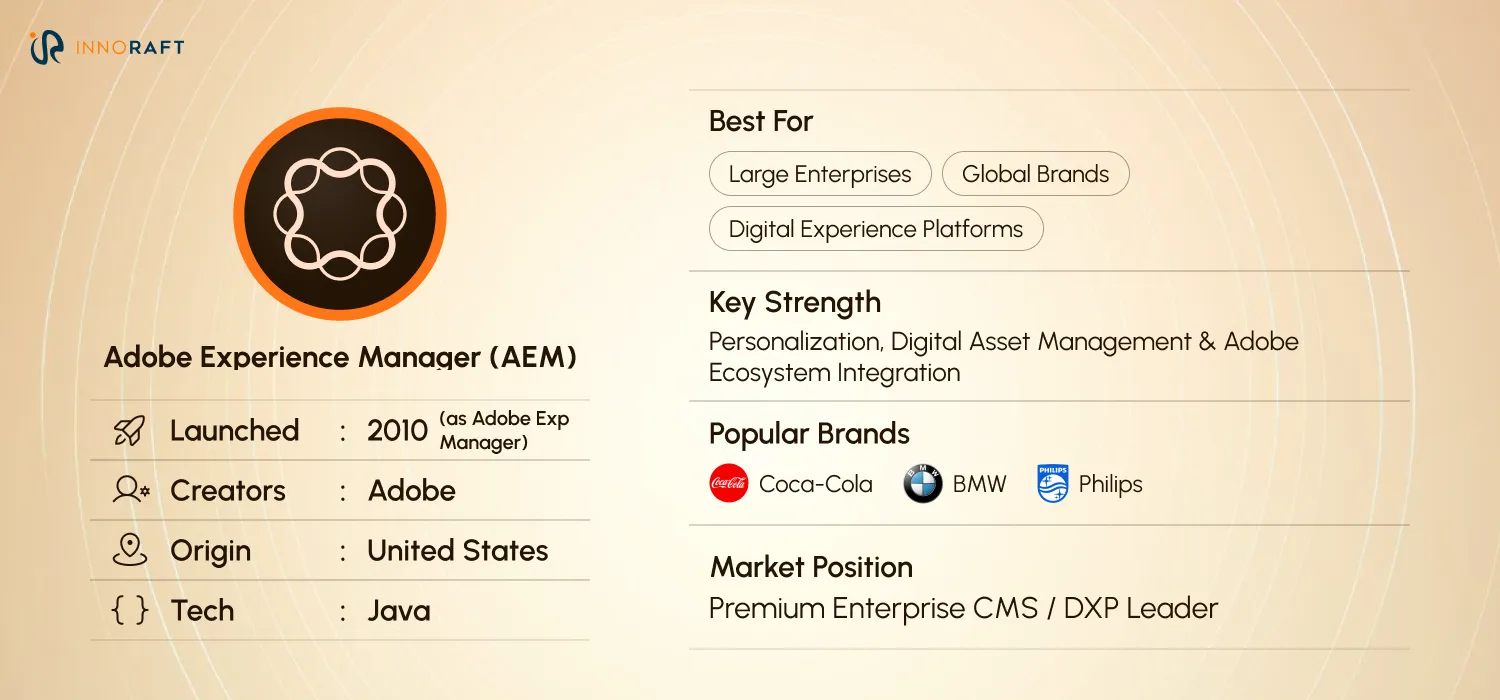
At the recent Adobe 2026 Summit, leadership essentially crowned AEM the absolute core of their ongoing digital strategy. Leadership framed this as an essential context layer, designed to support both regular customers and modern AI agents. Connecting smart visibility tools, tailored LLM frameworks, and specialized AEM pipelines clearly broadens your foundational market footprint. This shift entirely redefines how people discover, navigate, and perceive brand presence across all available modern digital channels.
2026 Enterprise CMS Requirements and How These CMS Measure Up to Them
Enterprise CMS decisions in 2026 are rarely straightforward. The wrong choice creates years of technical debt, security exposure, or content team frustration. Here's how Drupal vs WordPress vs AEM compares against the five criteria that matter the most to enterprise buyers today.
Security and Complex Governance
This is where the platforms diverge most sharply. Drupal is widely regarded as one of the most security-focused open-source CMS platforms available. Its dedicated Security Team monitors vulnerabilities, releases structured patches, and maintains a transparent advisory process. Built-in Role-Based Access Control (RBAC) lets teams define granular permissions at the content type and action level, something that matters enormously when dozens of editors across departments are touching the same platform.
Drupal can support organizations pursuing HIPAA, FedRAMP, GDPR, SOC 2, and ISO 27001 requirements when deployed on compliant infrastructure and governed appropriately. Hosting platforms like Acquia, which has established government-focused offerings, provide the infrastructure layer that makes this possible.
On the other hand, when it comes to Drupal Vs WordPress security, WordPress remains the most frequently attacked CMS on the internet. That is partly a function of its scale, but it is also structural: security depends heavily on which plugins you install, how up to date they are, and how carefully your hosting environment is hardened. A WordPress VIP implementation with SSO, managed hosting, WAF, and governance controls can absolutely satisfy enterprise compliance requirements. Drupal, however, often requires less customization to reach the same governance and compliance baseline.
While AEM delivers excellent security leveraging Adobe's enterprise infrastructure, properly hardening that closed system demands highly specialized talent. Sure, that compliance record looks consistently strong, but keeping things perfect drains available capital.
The takeaway: When it comes to Drupal vs WordPress vs AEM, Drupal remains the smartest open-source investment to navigate regulated spaces like government, healthcare, or finance. WordPress absolutely handles enterprise compliance, but you simply must build it out intentionally.
Scalability and Cloud-Native Performance
Honestly, Drupal feels tailor-made for intense, high-traffic ecosystems. It powers 6.4% of the top 100,000 websites and 7.1% of the top 10,000. We're talking about platforms handling millions of daily views alongside massive content libraries. Hosts like Acquia and Pantheon give you built-in auto-scaling, WAF, and DDoS armor tuned exactly for these workloads.
WordPress scales fine, sure, but your mileage depends heavily on underlying architectural choices. Bog it down with heavy plugins, and you'll hit performance walls faster than comparable Drupal deployments. WordPress VIP solves those headaches via aggressive caching, though you trade that convenience for vendor lock-in.
AEM brings dependable auto-scaling and strong SLAs by integrating smoothly with Adobe’s Managed Cloud. But in the Adobe Experience Manager vs Drupal scalability comparison, Adobe still has some operational friction, unless your team already lives inside that specific environment.
Ultimately: Drupal delivers unmatched cloud-native scalability without leaving true open-source economics behind. AEM leads on managed performance for enterprise brands willing to pay for it.
Omnichannel Composability and Integrations
By 2026, adopting a headless, composable CMS is no longer a passing trend; it is mandatory. Drupal practically defined this API-first approach way back in version 8. Because REST alongside JSON:API sits right inside the core, this headless Drupal setup acts as the perfect anchor for ambitious digital experience platforms. It seamlessly connects custom enterprise stacks, CRMs, plus front-end frameworks like Next.js. Need to scale globally? Drupal's multisite toolkit easily lets enterprises juggle dozens of distinct regional deployments through one central hub.
WordPress also offers a growing headless ecosystem. Tools like Faust.js and WPGraphQL have made it a credible headless option, and its plugin marketplace means integrations with popular SaaS tools are often available out of the box.
AEM leads on native integrations within the Adobe suite; Analytics, Target, Campaign, and Creative Cloud work seamlessly together. Outside that ecosystem, integrations require considerably more custom work.
Bottom line: in the Drupal vs WordPress vs AEM debate, Drupal remains the strongest open-source choice for composable, API-driven architectures, especially for multi-brand or multi-region enterprises. AEM wins for organizations deep in the Adobe ecosystem.
Editorial Workflow, Content Velocity, and AI-Driven Authoring
Enterprise content governance is not just about permissions but also about how content moves from draft to published across teams and regions. If your team needs rigid approvals, Drupal shines. The native workflow tracks draft approvals and multi-stage release cycles without fuss. That model fits large organizations needing multiple executives to sign off before going live. Additionally, the implementation of AI in Drupal makes it the ideal choice for futuristic enterprises.
When it comes to sheer speed, WordPress wins out. The Gutenberg editor just feels natural. Plus, a massive ecosystem of AI plugins helps marketing teams draft, polish, and push out content without bothering IT. If volume and velocity drive your strategy, that's huge.
That said, Drupal’s creator experience is definitely catching up. Backed by community leaders, the recent 2025 Drupal AI Initiative is finally baking smart tagging, automated workflows, and content suggestions right into the core system. They are also rolling out pre-packaged recipes and a cleaner interface to make daily life easier for non-technical folks.
Still, in the Drupal vs AEM debate, AEM easily boasts the most mature AI features thanks to Adobe Sensei. It powers everything from predictive analytics and auto-cropping to personalized recommendations across massive global operations.
Bottom line: WordPress leads on day-to-day authoring speed. Drupal leads on structured editorial workflow and governance. AEM leads on AI-driven personalization at scale.
Total Cost of Ownership
Drupal and WordPress are both open-source with no licensing fees, but their ongoing cost profiles differ. Drupal typically requires more upfront investment in development and architecture, but delivers a stable, secure, and highly customizable platform without ongoing plugin licensing costs. It also offers strong enterprise search capabilities through integrations with Solr and Elasticsearch.
When it comes to Drupal vs WordPress, the latter has a lower entry point. But enterprise use often involves significant spending on premium plugins, managed hosting tiers, security tooling, and the development effort to manage upgrade compatibility when plugins conflict with core updates.
AEM carries the highest total cost of ownership by a significant margin. Licensing alone can run into six figures annually, before accounting for implementation, managed cloud costs, and the specialist expertise required to operate the platform.
In conclusion, when it comes to cost considerations between Drupal vs WordPress vs AEM, Drupal and WordPress are the most cost-effective open-source options. AEM is a premium investment suited to organizations with correspondingly premium requirements and budgets. When executives evaluate upgrade hurdles, updating WordPress typically feels much simpler, yet those famously painful major Drupal migrations are surprisingly manageable today thanks to smarter tooling.
Best Use Cases: Which CMS Should You Choose?
| Choose Drupal When… | Choose WordPress When… | Consider AEM When… |
| You need support for HIPAA, FedRAMP, or GDPR compliance | You need fast time-to-market | You are a global brand in Adobe's ecosystem |
| Your site manages complex, structured content | You run a content-heavy blog, news, or media site | You need AI-driven personalization at scale |
| You manage multiple brands or regions from one platform | Your team has limited developer resources | You have a budget for premium licensing and implementation |
| You work in government, finance, or higher education | You rely on a large plugin marketplace | You want native Adobe Creative Cloud and DAM integration |
| You need an advanced editorial workflow and content approvals | You are an SMB or startup needing an affordable CMS | You manage high-volume personalized campaigns globally |
Conclusion: What Is the Best CMS for Enterprise Websites in 2026?
The right enterprise Content Management System depends on your organization's priorities. Here is a practical way to think through the decision:
If governance and compliance are your primary concern, Drupal is the most defensible open-source choice. Its native RBAC, structured security model, and suitability for regulated industries make it the platform most enterprise architects reach for in government, healthcare, and finance.
When speed and complete content team freedom drive your strategy, WordPress makes perfect business sense. With the right enterprise hosting tier, headless architecture, and governance controls in place, it supports significant scale while keeping content teams productive.
If AI-driven personalization is mission-critical, AEM deserves serious evaluation. No other platform in this comparison matches its native personalization depth for enterprises already running Adobe stack products.
Enterprise CMS Comparison between Drupal, WordPress, and AEM reveals that each has earned its place in the modern CMS landscape. The question is never which platform is best in the abstract, but rather which one aligns with your team's capacity, your compliance obligations, and your five-year content strategy.
Want to know which CMS suits your business goals better? Connect with our experts and make your choice today!
FAQ
Frequently Asked Questions
Didn’t find what you were looking for here?