18 Sep, 2026
What Is Digital Customer Experience? A Comprehensive Guide


Earning customer loyalty as a brand used to be easier once. You give them a good product or great service experience with a smiling face, and they will rave about your brand to everyone you know. But with years, things have changed quite a lot.
Nowadays, you probably won't meet half of your customers, and selling only good products in a saturated market is not enough. Today you have to balance the ridiculously complex digital world to make your customers happy while also bolstering your business bottomline.
A strong digital customer experience (DCX) strategy has become one of the biggest levers you can use to achieve both goals mentioned above. However, it is also one of the more misunderstood terms in customer strategy, often confused with plain old "customer service". A lot of time companies treat it as a design problem and hand it off to a UX team. But in reality, DCX touches product, marketing, support, and engineering- all at once, and whenever teams stop talking to one another, it fails.
In the following guide, we will discuss in depth about what DCX actually means, why it matters, the stages customers move through, and how to build a Digital customer experience strategy around it. The insights here are drawn straight from the experiences of experts here at Innoraft, rebuilding their digital touchpoints and managing shifting customer expectations.
What is Digital Customer Experience (DCX)?
Digital customer experience (DCX) is how a customer perceives and feels about a brand based on every online interaction they have with it. It includes the website, the app, support chat, email, and every other digital touchpoint, plus the back-end processes that shape how those touchpoints perform.
A customer forms this impression across dozens of small moments, not one big one. Some of these moments happen before they've even decided to buy.
| Touchpoint stage | What it covers | Examples |
| Pre-purchase | Interactions before a buying decision is made | Search engines and SEO, digital ads, blogs and content, social media browsing |
| Purchase | Interactions during the active buying process | Website and app navigation, live chat, checkout gateways, promo codes |
| Post-purchase | Interactions after the sale, aimed at retention | Order confirmation emails, support portals, loyalty apps, CSAT/NPS surveys |
DCX often gets used interchangeably with customer experience (CX), but they aren't the same thing. CX is the umbrella term covering every interaction a customer has with a business, physical, human, and digital. Digital customer experience management is the portion of that journey shaped by digital touchpoints, and that portion keeps expanding as voice assistants, connected devices, and AI agents become part of how customers interact with brands.
| Customer Experience (CX) | Digital Customer Experience (DCX) | |
| Scope | Entire customer journey | Digital portion of the journey |
| Touchpoints | Physical, human, and digital | Websites, apps, portals, chatbots, social, email |
| Human interaction | Salespeople, store staff, call centers | Live chat, chatbots, digital support |
| Physical experience | Stores, packaging, delivery, events | Generally out of scope unless digitally enabled |
| Focus | Overall brand perception | Perception formed through digital channels |
| Key concerns | Service quality, trust, consistency | Usability, accessibility, personalization, omnichannel continuity |
Here's the part most teams miss: customers don't separate the two. They don't think "that was a bad Customer experience in digital channels but a fine overall experience." They walk away with one impression of the brand, period.
This confusion shows up most often in how companies are organized internally. A brand might have a fantastic in-store team and a genuinely broken mobile app, and leadership still wonders why NPS scores are inconsistent. In many organizations, giving DCX a clearer owner and its own metrics, even if it stays under the same broader Customer experience optimization process, makes it much easier to spot exactly where a digital touchpoint is dragging down the overall score.
Why Does DCX Matter?
Digital customer experience matters because customer expectations are now set by the best digital experience anyone has ever had, not by direct competitors. A slow checkout or a confusing app gets compared to Amazon, whether that's fair or not.
A few reasons Digital customer experience platform deserves board-level attention:
- Rising expectations. Customers benchmark every brand against the smoothest digital interaction they've ever had. A clunky form on your site reads as a red flag, even if your product is excellent.
- Revenue and retention. A well-designed digital experience shortens the path to purchase and reduces the number of customers who quietly disappear before renewal.
- Operational efficiency. Good self-service, done through clear knowledge bases and well-scoped automation, cuts inbound support volume without customers feeling shortchanged.
- Data-driven insight. Every digital interaction leaves a trail. Teams that study this trail know exactly where customers drop off and what they're actually searching for, not what the org chart assumes.
- Competitive differentiation. When two products are priced similarly and do roughly the same job, the deciding factor is usually how effortless the digital experience feels.
- Faster problem detection. A spike in abandoned carts or a sudden jump in support tickets about the same issue shows up in digital data almost immediately. Waiting for a quarterly survey to catch the same problem means losing customers in the meantime.
One caveat worth repeating: customers don't experience online and offline interactions as separate worlds. You can have a UX strategy built around the latest AI capabilities, but if the experience as a whole feels confusing or disconnected, that is what they remember. Get the digital layer wrong, and the friction can spill over into how they perceive the entire brand relationship.
There's also a cost side to this that boards tend to underweight. A support ticket that could have been resolved by a well-written help article still costs a company money every single time an agent has to answer it manually. Multiply that across a few thousand tickets a month, and Digital customer experience quietly turns into a line item on the budget, not just a design preference.
What are the 6 Stages of the DCX Journey?
The framework we use in this guide breaks the Digital customer journey into six stages, from first contact to advocacy. Different teams slice this journey differently, and there's no single industry-standard version of it, but these six stages cover the moments that most consistently make or break the relationship. Each one has its own touchpoints, its own risks, and its own way of losing a customer if it's handled poorly.
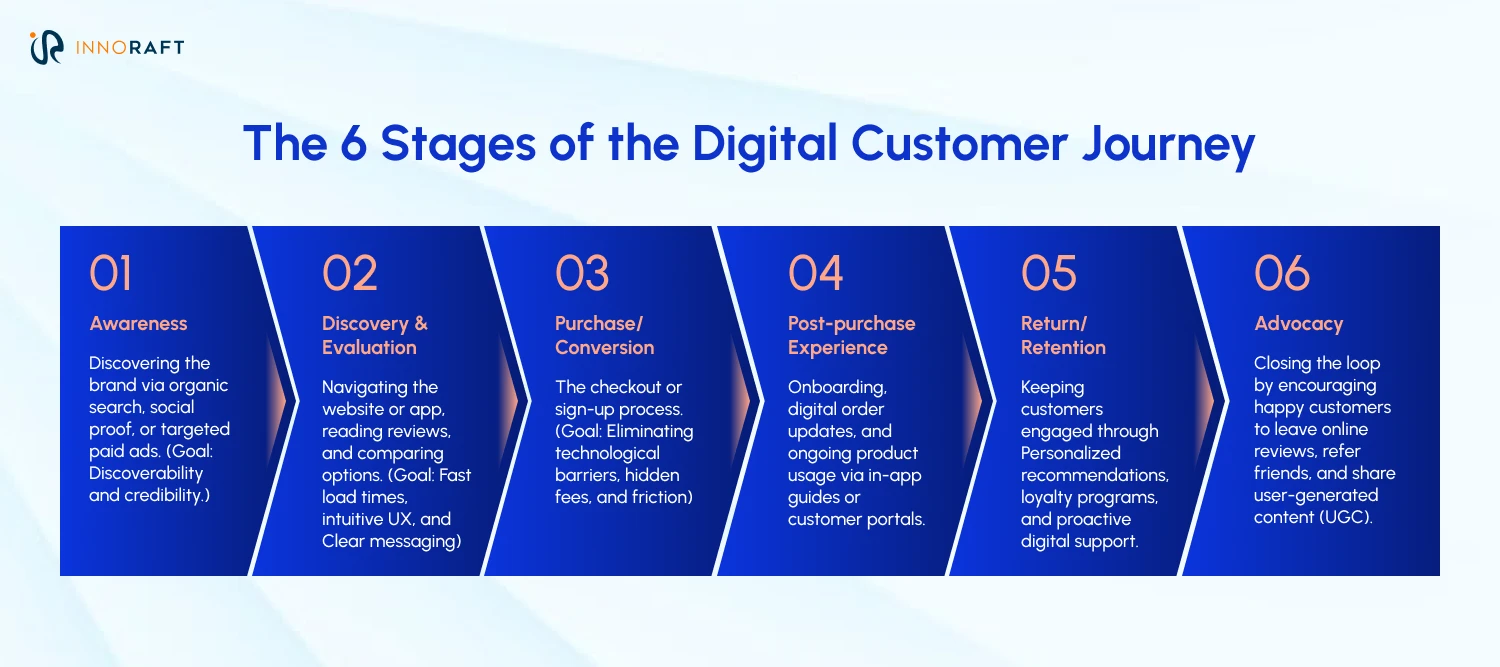
Awareness
A customer either has a problem and goes looking for a solution, or stumbles onto your brand while researching something else. Either way, the core touchpoints stay the same: search, social, ads, blogs, referrals. If your visibility is weak or your messaging is generic, you lose the customer before the journey even properly starts.
Consideration
This is where the customer digs into what you actually offer, comparing your digital customer experience platform such as apps or website, pricing, and reviews against competitors. Any ambiguity here, an unclear price, a missing feature comparison, a thin review page, pushes them toward whoever answered the question more clearly.
Decision
The customer has chosen you, but the decision isn't final until checkout is done. Digital customer experience management issues such as unexpected costs, a clunky payment flow, or a poor mobile experience at this exact moment can still cost you the sale, even after winning the previous two stages.
Onboarding
This is where the relationship actually begins. Benchmark data puts average user activation at just 37.5%, which means most new signups never reach the point where they experience the product's core value, not necessarily that they've abandoned the product entirely. Some stay stuck in a half-used account for weeks before either activating late or quietly churning. The friction behind that number is rarely one single thing. It's usually a mix of unclear setup steps, too many decisions asked of the user too early, and a lack of visible progress toward the "aha" moment the product is supposed to deliver.
Engagement & Support
The customer is now part of your ecosystem, using the app, emailing support, checking notifications. Slow response times, disconnected channels, and irrelevant offers at this stage quietly erode the relationship until they leave without much warning.
Retention & Advocacy
The final stage decides whether the customer stays and whether they talk about you. Personalized communication, working loyalty programs, and genuine service recovery are the standard Digital CX best practices that keeps them around. Declining service quality and unrewarded loyalty do the opposite, and they tell other people about it.
One thing worth flagging: this journey isn't a straight line. A customer might jump from consideration back to awareness, or contact support before they've even finished onboarding. Someone might read a comparison blog post, get distracted, come back three weeks later through a retargeting ad, and land straight in the decision stage without ever visiting the pricing page again. A Digital customer experience strategy has to work regardless of where someone enters it, which means every stage needs to be able to stand on its own instead of assuming the customer arrived from the one before it.
What are the Core Pillars of a Winning DCX Strategy?
A good digital customer experience strategy starts with a clear understanding of customers and how they move through their journey. From there, it’s about connecting the different touchpoints, making each interaction useful and relevant, and continually learning from what happens.
Deep Understanding of The Customer
This is one of the Digital CX best practices. A team needs to know who its customers are, what they're trying to get done, what frustrates them, and how their needs shift by segment and context. This comes from combining customer research, behavioral data, direct feedback, and journey analytics. Skip this step and personalization turns into guesswork, and journey optimization ends up reflecting how the company thinks the journey works rather than how customers actually move through it.
Session recordings, heatmaps, and support transcripts tend to surface friction that surveys miss entirely, mainly because customers don't always notice or report the small moments where they hesitate or backtrack. Customers will say they want more features in a feedback form and then abandon a signup flow over a single confusing field. Watch the behavior, not just the stated preference.
Journey-Centered Experience Design
Customers don't move through the website, then app, then blog, then support in a fixed order. Good digital customer experience platform design accounts for that by mapping:
- Critical customer journeys
- Customer goals at each stage
- Points of friction
- Key decision moments
- Cross-channel handoffs
- Where the journey currently fails
- Opportunities to remove steps entirely
Connected, Consistent Experiences
A customer might discover a brand on Google, check reviews on social media, fill out a contact form, then send a support text about a problem. Each of those interactions needs to carry context from the last one. A customer shouldn't have to repeat their issue at every handoff. This requires connected data, systems, and content across channels. The real test: does the customer feel like they're dealing with one brand, or several disconnected departments?
Most Digital customer journey fragmentation isn't intentional. It happens because marketing, sales, and support each buy their own tools on their own timelines, and nobody owns the job of making those tools talk to each other. In most enterprise environments, a single unified system isn't realistic. It's more practical to designate one system, often a CDP or CRM, as the reference point for identity and interaction history, and integrate the rest around it, so every tool at least reads from the same version of a customer's story even if the data itself lives in several places.
Relevant and Effortless Interactions
Great Digital customer experience management removes friction. That means easy navigation, fast load times, clear information, and working self-service, paired with easy access to a human when self-service isn't enough. On top of that, relevance matters: contextual recommendations, recognition of past interactions, and offers timed to where the customer actually is. This is where personalization, automation, and empathy-driven UX design strategy earn their keep. None of it works, though, without clear consent and data-governance practices behind it. Personalization built on data a customer didn't knowingly share, or can't see or correct, tends to feel invasive rather than helpful, and it creates real compliance exposure under regulations like GDPR and CCPA.
Continuous Measurement and Improvement
A Digital customer experience strategy isn't a project with an end date. It needs an ongoing loop:
- Set clear goals and metrics. Decide what success looks like, higher conversions, faster load times, fewer support tickets, and track NPS, CSAT, and customer effort score against it.
- Measure across channels. Look at what customers do on your website and app, but don't stop at analytics. On-site feedback and support conversations can reveal why they behave that way and where they're running into problems.
- Build a feedback loop. Bring analytics, feedback, and service records into one place, and run regular cross-functional reviews with marketing, product, and support.
- Test before rolling out. Test new layouts and copy with A/B tests before rolling them out more widely. Smaller releases also make it easier to see what works without changing the whole experience at once.
- Review what changed. Once an update is live, look at the metrics that were supposed to move and see whether they actually did. If customer expectations or the technology around them changes, your goals may need to change with them.
What are the Future Trends in Digital Customer Experience?
AI and automation will drive the future of Digital customer experience strategy, but they’re only part of what comes next.The underlying relationship between customers and digital products is shifting, and along with AI/ML, this shift will have a larger impact on the future of customer experience.
| Trend | What's changing | Strategic shift required |
| Beyond the screen | Customers reach brands through wearables, voice, vehicles, and spatial interfaces | Design experiences that aren't tied to one device |
| AI agents as an audience | Customers delegate discovery and comparison to AI systems | Make your brand machine-discoverable, not just human-friendly |
| The end of the single destination | Discovery and transactions happen on marketplaces, search, and social, not just your own site | Build consistency across third-party environments, not just your own |
| Ephemeral, assembled interfaces | Instead of a fixed app screen or page layout, the interface itself gets built on the fly, pulling the right content, offers, and actions based on who the customer is and what they're doing right now | Build systems that generate the right interaction in the moment |
| Phygital experience layers | Physical and digital interactions merge into one connected experience | Design the combined journey instead of two separate ones |
Each of these shifts asks the same underlying question: is your brand built to show up wherever the customer happens to be, or only where you expected them to be? Businesses that answer that honestly are the ones that will still be relevant when the next interface arrives.
None of this means throwing out what already works. A well-run website and a clear checkout flow aren't going anywhere. What's changing is the assumption that customer experience in digital channels is only limited to these common entry points. The brands paying attention now, testing how their product pages read to an AI agent, checking how their content performs on marketplaces they don't own, will have a real head start once these shifts stop being trends and start being table stakes.
Conclusion: What's the Best Way to Start Improving Your Digital Customer Experience?
The best way to start is by mapping where your current Digital customer experience management breaks down, then fixing the highest-friction points first instead of chasing every new tool on the market. Customer expectations keep moving, and the businesses that keep up are the ones actually listening to behavioral data and feedback, not the ones adopting technology for its own sake. Pick one stage, usually onboarding or checkout, where the drop-off is clearest, fix it, measure the change, and use that as proof to fund the next fix.
A Digital customer experience strategy should always come back to the customer: who they are, what they're trying to do, and where they're currently getting stuck. That's the work Innoraft does with enterprise teams every day, auditing digital touchpoints, redesigning journeys, and building the connected systems behind them.
Contact our experts today to get started on implementing the future of Digital customer experience for your business.
FAQ
Frequently Asked Questions
Didn’t find what you were looking for here?