16 Mar, 2026
User-Centric vs Data-Driven UX Strategy: Finding the Right Balance


Look at your screen right now. Every pixel, every button placement, and every color choice was likely the subject of a fierce debate. Was it a designer's empathy that shaped the interface, or a dashboard of metrics?
That is the core dilemma product teams face today.Product teams today are practically drowning in dashboards. We've got unprecedented access to AI insights and behavioral tracking, all fueled by a relentless demand for immediate ROI. Even so, if you think about the apps you actually enjoy using, a spreadsheet probably didn't dream them up.
Making sense of this tension means looking at two distinct camps:
- User-Centric Design: Sure, it is sometimes labeled as just "empathy." But in reality, a user-centric UX strategy is grounded in talking to real people. This approach relies on qualitative grunt work- things like field studies, one-on-one interviews, and watching someone actually try to use your product.
- Data-Driven Analytics: Then you have the side with hard numbers. Instead of individual conversations, you look at the aggregate through UX analytics tools. It’s all about quantitative metrics, building behavioral funnels, running A/B tests, and chasing statistical significance.
The thesis here is simple but hard to execute: Success lies in a symbiotic balance. Intuition sparks innovation. Data validates and scales it.
The Power of User-Centric UX Strategy
People often dismiss "gut feeling" in business. They shouldn't.
When it comes to a seasoned professional, intuition isn't a random guess. It is subconscious expertise. It’s rapid pattern recognition built from repeated, relentless exposure to user frustrations and unmet needs. True intuition is fueled by deep generative user research in UX; ethnographic studies, field observations, and contextual inquiries.
Data is fantastic at finding the "local maximum." It will help you build the absolute best version of a current idea. But it won't push you beyond incrementalism. Paradigm shifts often emerge before there is enough historical behavioral data or UX performance metrics to validate them.
Then, there is the emotional weight of a product. A huge majority of users judge a company's credibility based purely on visual design. A spreadsheet simply cannot measure the "soul" of a brand, the building of trust, or the emotional resonance of a perfectly timed micro-interaction.
The Case for Data-Driven Customer Experience Strategy
Numbers don’t have egos, but they often expose ours. That is arguably the greatest strength of a data-driven approach.
Bring hard interaction numbers into a meeting, and personal bias walks right out the door. It is your best defense against any misconceptions regarding UX optimization strategy. Egos deflate. Instead of arguing over subjective preferences, the team is forced to look at actual, observable user behavior.
Beyond settling debates, experienced web design services company always use numbers to translate design into business value, bridging the gap between the UX professionals and the C-Suite leaders. Connect a workflow tweak directly to a bump in retention or customer lifetime value, and executives immediately understand the ROI.
Scale makes this dynamic even stronger. When you are dealing with millions of daily active users, behavior analytics in UX become statistically undeniable. You stop guessing. That drastically lowers the risk of shipping a disastrous update.
Just remember one thing. None of this matters if your tracking is broken. Poorly instrumented analytics often create false confidence in completely incorrect assumptions.
When you should lead with data:
- Optimizing existing user flows with measurable outcomes.
- Testing controlled UI variations where you can get a clean, statistical comparison.
Data vs Intuition in UX: The Danger of the Extremes
Lean too far in either direction, and your product will suffer.
The Trap of Data Myopia
UX performance metrics and analytics are incredibly good at telling you exactly what is happening. They will proudly show you that 40% of users abandoned their cart on step two. But they will sit silently when you ask why. UX KPIs and metrics are excellent at measuring isolated actions, but they rarely capture the full complexity of a user's experience. Over-relying on numbers leads to severe experimentation fatigue and decision gridlock.
The Illusion of the "Gut"
Designing in a vacuum without the validation of a data-driven customer experience strategy is just as deadly. It leads to vanity projects. These products might look beautiful in a portfolio, but they fail to solve actual user problems, usually resulting in highly expensive redesign failures.
Metric Misalignment
Perhaps the most modern danger for a user-centric UX strategy is optimizing for the wrong numbers. It is very easy to drive up short-term clicks (CTR) by using clickbait UI or dark patterns. But you do so at the direct expense of long-term user trust and overall experience quality. This is a classic example of Goodhart’s Law in action: When a measure becomes a target, it ceases to be a good measure.
Frameworks for Striking the Balance
How do mature teams actually blend these two philosophies for balanced UX optimization strategy? They use procedural models like the UX Decision Lifecycle.
- Discovery: Use qualitative research and intuitive empathy to frame the right problem.
- Ideation: Where the actual design thinking happens. You take the research and place a few confident, creative bets.
- Validation: Putting the prototype in front of real people. You run usability tests to see if your idea actually fixes the user's headache.
- Optimization: Rolling it out and watching the numbers. You launch A/B tests to tweak the final interface based on live traffic.
So how do you actually use this for a long-term user-centric UX strategy? Here is a quick cheat sheet for your next sprint planning:
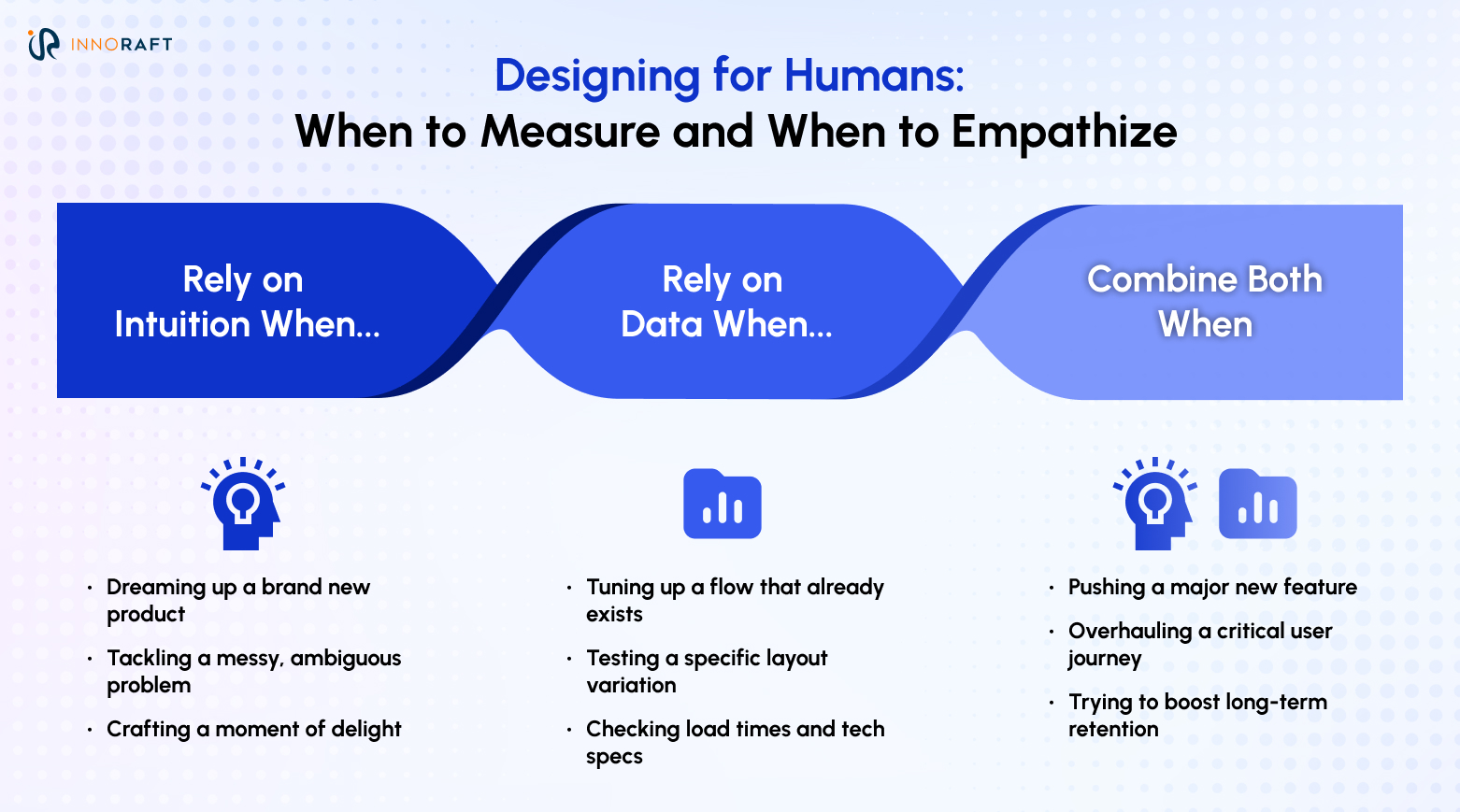
The Real Takeaway: Stop trying to build a purely "data-driven" customer experience strategy. The most mature product teams are "data-informed." They let the metrics cast a vote, but they never let the UX analytics tools dictate the entire roadmap. Let data act as a vital signal alongside product strategy and human insight, rather than letting metrics unilaterally dictate your roadmap.
Real-World Playbooks
In the battle of data vs intuition in UX, big tech companies don't just pick a side. They blend both approaches to fit their specific culture.
Take Netflix. Their entire product culture revolves around experimentation. Sure, massive datasets and algorithms run their personalization engine. But they don't stop there. They spend heavy resources on behavior analytics in UX, leveraging qualitative research to figure out the exact emotional cues, like the specific facial expression in a movie poster, that actually get someone to hit play. The takeaway? Use experimentation to scale your optimization.
Apple is a completely different beast. They lean hard into a vision-led UX optimization strategy, where aesthetic intuition and human-first design drive the bus. That said, the idea that Apple just ignores user testing is a total myth. They run incredibly rigorous, highly secretive usability gut-checks internally before the public ever sees a thing. The takeaway? Let a strong design vision drive your paradigm shifts.
Then you have Spotify, sitting comfortably in the middle as a data-inspired machine with their balanced customer experience strategy. They map billions of listening habits. Yet, features like Discover Weekly feel very personal, almost like a mixtape from a friend. That happens because they pair raw data with heavy human curation and a deeply empathetic UI. The takeaway? Data can actually inspire a more human experience.
Wrapping It Up
Let’s forget the buzzwords for a second and just remember how these three pieces of user-centric UX strategy fit together:
- Your intuition comes up with the initial spark.
- Qualitative research tells you who you are actually building it for.
- Analytics swoop in at the end to prove whether the whole thing worked.
We know that bad usability kills a massive number of digital products every year. Balancing your gut with your dashboards is no longer optional if you want your product to survive. The future of UX optimization strategy has absolutely nothing to do with misalignment between designers and data scientists. The real winners will just be the teams confident enough to know who should be holding the mic, and when to actually listen to them.
Want to leverage the best of both worlds with data and expert intuition for your business UX strategy? Contact our experts today!
FAQ
Frequently Asked Questions
The most mature teams aim to be data-informed, not just data-driven. A practical way to achieve this is through the UX decision lifecycle:
- Discovery & Ideation: Use qualitative research and intuition to frame the problem and design creative solutions.
- Validation & Optimization: Use real-world usability tests and A/B analytics to test the prototype, tweak the final interface, and scale what works.
Didn’t find what you were looking for here?