13 May, 2026
The Complete Guide to Mobile App Development in 2026: Trends, Technologies & Strategy


It’s 2026, and it's time you stop obsessing over the download counts of your mobile app. This is because even if your app has millions of downloads, it still doesn’t matter if people uninstall after using the app once. The apps that win mobile app development in 2026 are the ones people return to again and again- these are the apps that have taken up a permanent space in the user’s daily life.
Industry benchmarks consistently reflect the same. Retention rate is now considered one of the most important parts of App development strategy 2026, indicating whether your mobile app is delivering value from the first use. In fact, average mobile app retention drops significantly by day 30, depending on the platform, meaning over 90% of users abandon most apps within a month of installing them. On the other hand, we have exponential market growth. According to GSMA, mobile technologies and services generated $7.6 trillion for the global economy, which is equivalent to 6.4% of GDP. As per the same report, the industry’s economic impact is expected to grow to $11.3 trillion by 2030, thanks to the adoption of 5G, AI, and other emerging technologies. Needless to say, between the sharp churn rates experienced by most mobile apps and the expanding market, the margin of error is small to null.
Now the questions that remain are these: What does the future of mobile applications look like? And how to make your app successful? The situation might seem daunting, but in the following guide, we will be covering all the steps, trends, tools, and challenges you need to know to compete in the 2026 mobile app market. So, let’s begin.
Why Do You Need a Retention Stack for Mobile App Development in 2026?
Your App development strategy 2026 doesn’t have a retention problem; it has a sequencing problem; they try to monetize before the habit is formed, re-engage before the core loop is proven, and optimize Layer 4 before Layer 1 is functional. The Mobile Retention Stack exists to fix that order. With this, you can effectively eliminate the gap between first-time app installs and long-term loyal users. As an experienced mobile app development services provider, our experts at Innoraft leverage mobile app development technologies to build sustainable mobile products through the following Mobile Retention Stack: four layers that must work in sequence. A failure at any layer limits everything above it.

There are many reasons for churn, such as insufficient usage, cost concerns, billing issues, finding better alternatives, technical glitches, and many others. It is important that you pay as much attention to any possible churn as you pay towards retaining the user from your app.
What is "Time to Value (TTV)" and How Does it Define Whether Your App Survives?
Time to value is all about how quickly a new user goes from first install to introductory screen to the core benefit of your app. Apps that reach a meaningful first action within the first session see significantly higher retention. Though TTV might not be listed as one of the flashy mobile app development trends 2026, research shows that it is important to complete all onboarding steps in less than a minute for almost three-quarters of respondents (72%). Onboarding length isn't universal, however. A banking app that skips identity verification to reduce friction creates a compliance problem, not a retention win. The right flow is the shortest one that still gets users to their first real value moment safely. Every extra step between install and the core action is a moment where users can, and often do, exit.
Section 1: How to Build the Right Strategy for Mobile App Development in 2026?
1.1 What's the Right Starting Point: MVP or Scalable Platform?
Before deciding on a mobile app development technologies stack, you need to figure out what brings users back. That repeated action, the one that becomes a habit over time, is your core user loop. Everything else gets built around it.
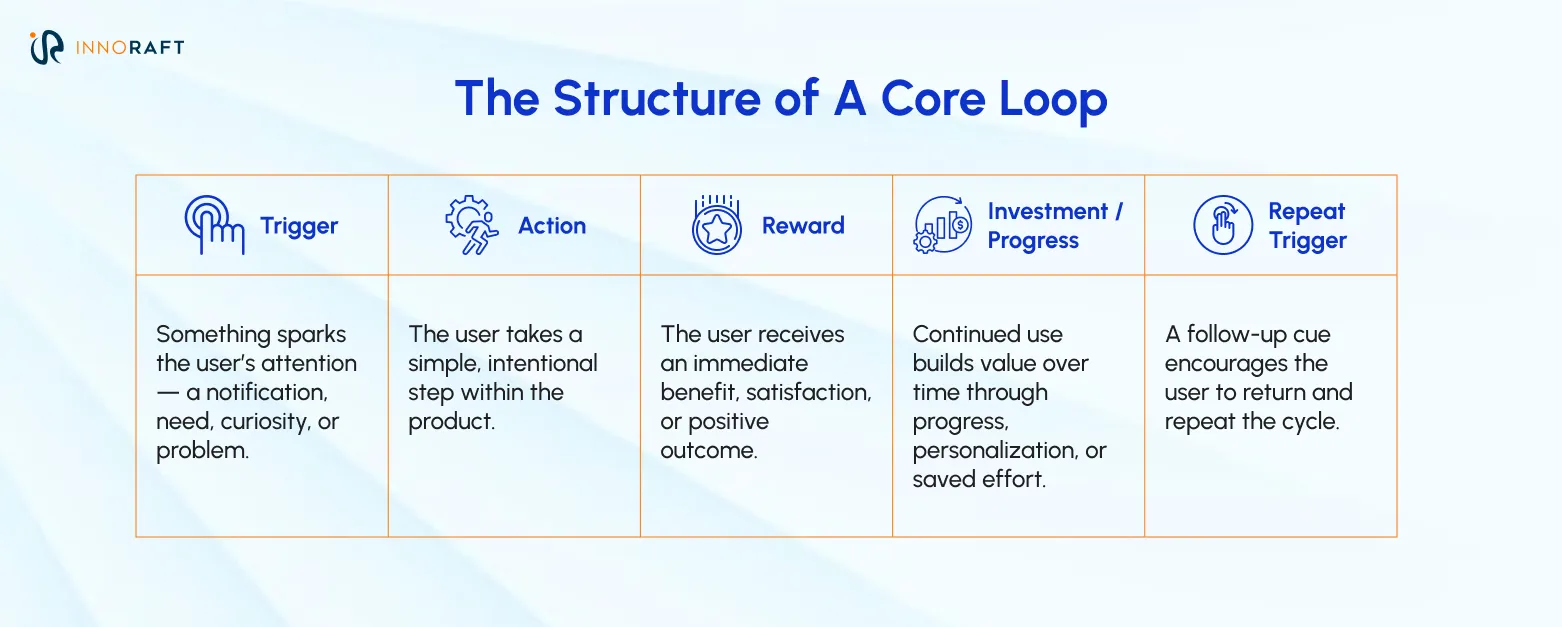
Choosing an architectural approach without verifying the core user loop negatively impacts the app's success. Which is why an MVP approach backed by a verified user loop can lead to better app success.
1.2 Should You Build, Buy, or Integrate?
Should you build an app from scratch, buy an off-the-shelf solution and customize it, or integrate third-party solutions and call it a day?- This one question will define your app development strategy 2026.
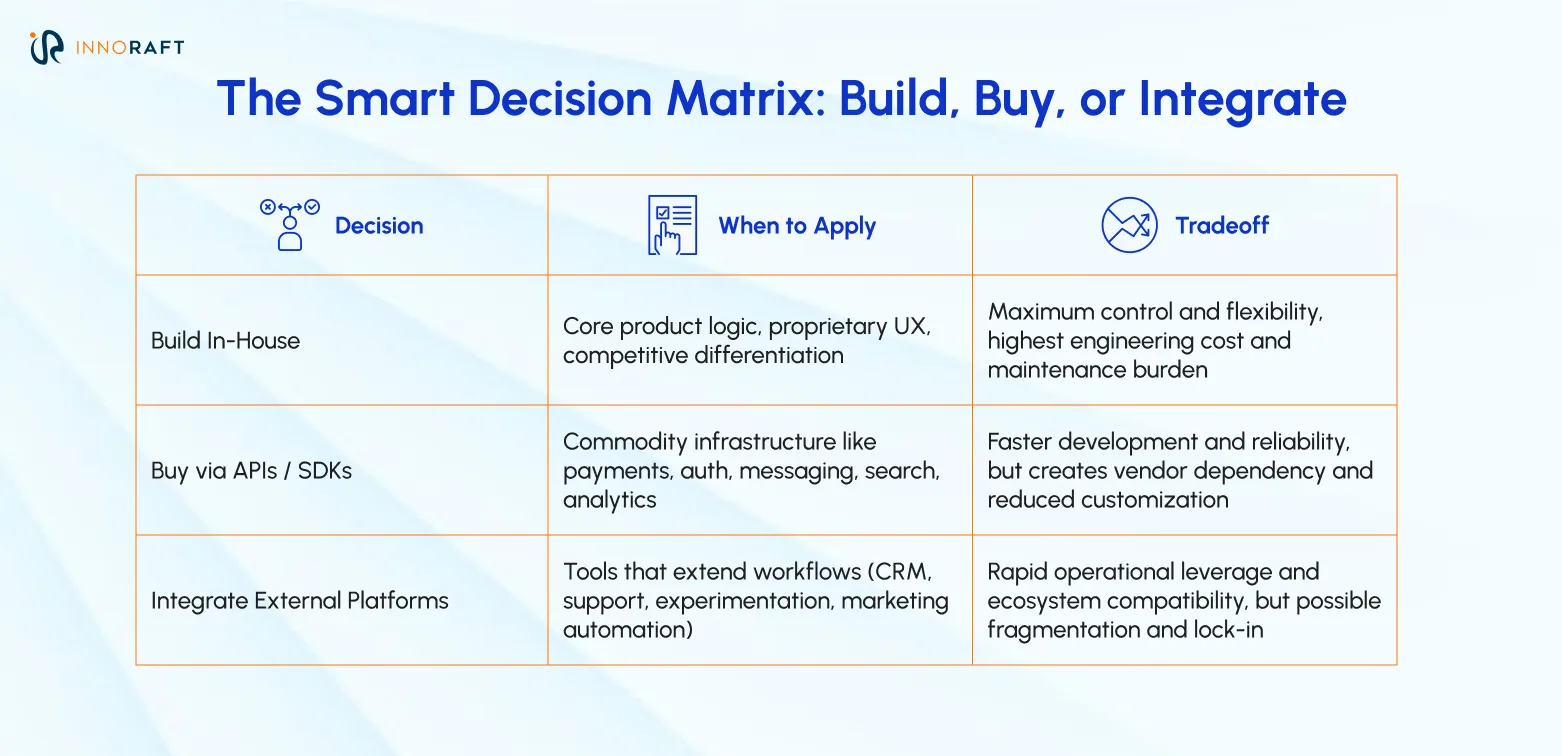
- Building from scratch means you own everything- the roadmap, the architecture, the quirks, and the maintenance bill. That control is real, but so is the cost: longer timelines, higher upfront spend, and an engineering commitment with mobile app development technologies that doesn't end at launch.
- Buying off-the-shelf or going with a SaaS platform flips that. You get to market faster and sidestep a lot of early technical risk. What you give up is flexibility. You're building inside someone else's system, and vendor lock-in plus recurring fees become permanent line items.
- Third-party API integration lands somewhere between the two. You're not starting from zero, and you're not fully boxed in either. It works well when you need a specific capability added, or when a responsive website can do the job as a progressive web app (PWA) without a full native build. Development moves faster, costs stay lower, and you're leaning on proven infrastructure. The catch is stability: you're only as reliable as the APIs you depend on.
A simple way to choose: if your business depends on features no off-the-shelf product can deliver, build. If you need to validate an idea quickly, launch standard functionality fast, or extend an existing product, buy or integrate first.
1.3 Native vs Cross-platform: What's the Best Choice in 2026?
Choosing between Flutter and React Native matters less than most teams think. What matters more is whether the Cross-platform app development framework fits how your team works, how fast you need to move, and what the product actually needs to do. For context on where the industry sits, data from the 2024 Stack Overflow Developer Survey puts Flutter and React Native among the most widely used cross-platform mobile frameworks.
| Use Case | Best Choice | Why? |
| Fast launch, single team | Flutter or React Native | Shared codebase, faster iteration |
| Performance-critical (graphics, AR) | Native Swift / Kotlin | Direct GPU and OS access |
| Shared logic, platform-native UI | Kotlin Multiplatform (KMP) | Business logic once, UI natively |
| UI consistency, design control | Flutter | Own rendering engine, pixel-perfect output |
1.4 How Do You Design for Retention from Day One?
On-boarding is not a setup flow- it's your product's first proof of value. Spotify plays a song. Calm starts a meditation. Notion opens a blank page. Each removes every step between install and the core promise. Industry benchmarks from OneSignal show apps with structured on-boarding messages earn 24% higher install-to-purchase conversion rates, emphasizing the importance of on-boarding for a successful future of mobile applications.
Section 2: What Architecture Actually Scales Beyond 10x Growth?
2.1 What Does Scalable Architecture Look Like and What Gets Teams in Trouble?
Modern apps run across three layers: client, backend, and an AI inference layer. Monolithic backends work well at an early scale. But the issue arises when teams need independent deployment or different scaling profiles across services, but the app development strategy 2026 does not allow these. The more dangerous failure: teams prematurely adopt microservices and struggle with distributed tracing, inter-service latency, and infrastructure cost. In most cases, a team of five will struggle to sustainably operate twelve microservices. Right-size architecture to actual scale, not hoped-for scale.
2.2 Why is Offline-First Still Critical in 2026?
Network connectivity is still uneven, across devices, markets, and contexts. The fix is straightforward: write to a local database first, sync when the connection comes back, and have a clear plan for what happens when the same data gets touched in two places. SQLite and Realm are the usual choices. Teams that don't think this through tend to find out the hard way, usually when a user on a train loses three minutes of work and never opens the app again.
2.3 GraphQL vs REST: What's the Best API Design for Mobile?
Here’s a brief comparison between REST and GraphQL to help you decide:
| Factor | REST | GraphQL |
| Complexity | Lower, widely understood | Higher, more setup required |
| Data fetching | Fixed endpoints, possible over-fetching | Precise queries, reduces mobile payload |
| Mobile constraint | Can over-fetch on slow networks | Designed to solve exactly this |
One caveat many development teams overlook: poorly designed GraphQL schemas create N+1 query problems at scale; a single client request triggering dozens of sequential database calls. GraphQL solves the client's over-fetching problem. It can accidentally create a server-side one.
Key takeaway: whether native or cross-platform app development, architecture decisions compound. A premature microservices migration, a poorly designed schema, or a missing offline layer all become exponentially harder to fix after launch.
Section 3: How Should You Actually Use AI in Mobile App Development?
3.1 What Separates an AI Feature from an AI-Native App?
"AI-powered" has become a marketing label. Genuine implementation of AI in mobile app development leverages the technology as an interface (predictive surfaces replacing manual input), AI as a decision engine (personalization and recommendation built into the core loop- TikTok's feed, Spotify's Discover Weekly), or AI as an automation layer (reducing repetitive tasks without user instruction). An AI feature that users can feel retains them. An AI feature added to a product description does not.
3.2 What Do Agentic AI Systems Actually Do?
Agentic AI is real in narrow, well-scoped domains. Task chaining, document summarization, and multi-step automation work today. Open-ended autonomy doesn't. Reliability gaps, inference latency, and cost at scale remain real constraints. According to the Stack Overflow Developer Survey 2025, most developers either don't use agents or stick to simpler tools, not from ignorance, but from testing. Human validation remains non-negotiable for Mobile App Development in 2026.
3.3 Edge AI vs Cloud AI: Which Should Your App Use?
Edge AI, Cloud AI, and a hybrid approach have become part of the key Mobile app development trends 2026. Here’s a brief look at each approach, what it is best for, and its limitations.
| Approach | Best For | Limitation |
| On-device (Edge AI) | Speed, privacy, offline response | Limited model size and complexity |
| Cloud AI | Power, flexibility, updatable models | Latency, cost, requires connectivity |
| Hybrid | Most production apps in 2026 | Increased architecture complexity |
In practice, a lot of teams land on something like this: the device handles intent recognition instantly, hands off anything complex to a cloud model, then brings the result back on-device. You get speed where it matters and capability where you need it, without the cost of running everything through the cloud.
Worth keeping in mind, though: the Stack Overflow Developer Survey 2025 found more developers actively distrust AI output (46%) than trust it (33%). Users are getting there too. Guardrails and observability aren't optional extras; they're what actually make an AI feature feel reliable rather than risky.
Section 4: What UI/UX Decisions Actually Drive Retention?
4.1 How Do You Design for Time to Value and Keep Users Past Session One?
Remove every unnecessary step between install and the first value moment, because each extra screen is a measurable churn event. Show users what they need right now. Save the advanced features for later, after they've already found a reason to stay. In the Future of mobile applications, the best interfaces eliminate a step before users realize they need to take it.
Motion should communicate, not decorate. A payment confirmation animation that expands a checkmark prevents the double-tap that creates a duplicate charge, and builds quiet confidence in the product. That's the standard for useful motion.
4.2 Why is Accessibility a Growth Lever?
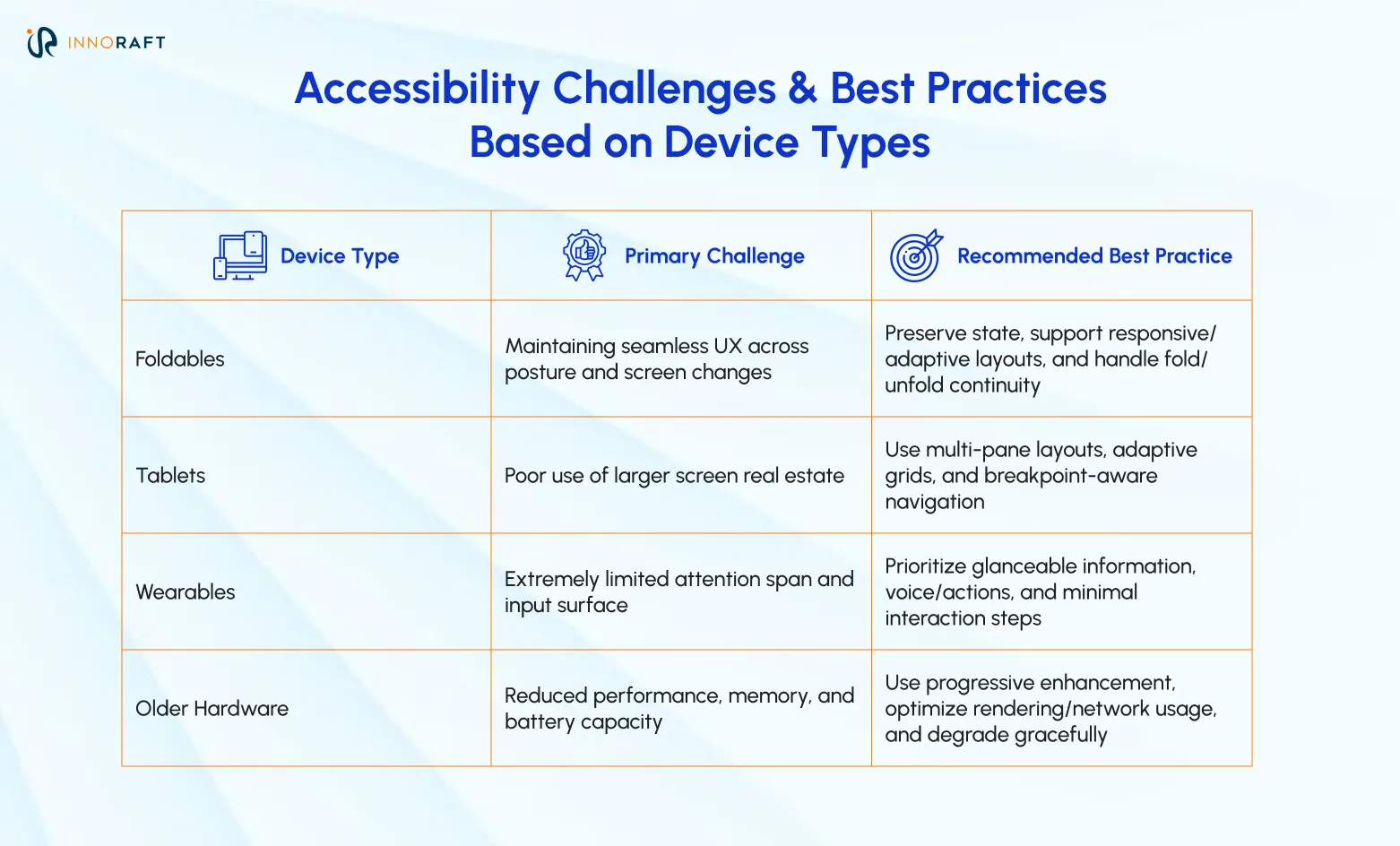
Accessible web and Mobile App Development in 2026 improves usability for all users. Clear contrast helps users in bright sunlight. Large tap targets help users with injuries. Logical navigation helps users on older hardware. Accessibility audits at Innoraft consistently surface friction affecting mainstream users just as often as edge cases.
Section 5: How Do Security and Privacy Become Product Features?
The shift toward passwordless is infrastructure-level, not cosmetic. Passkeys- cryptographic, device-bound, with no shared secret to steal, are the 2026 standard. Biometrics as primary auth, not fallback.
If your security posture for cross-platform app development is immature, prioritize three things: authentication hardening, end-to-end encryption in transit and at rest, and secure credential storage via Keychain (iOS) and Keystore (Android). Before touching cryptography, audit your API surface. Most breaches don't happen through broken encryption. They happen through misconfigured APIs. An exposed endpoint with weak auth validation causes more real-world damage than a weak cipher.
Compliance laws such as GDPR, CCPA, emerging youth protections are best handled at the architecture level. Building it in from sprint one costs a fraction of retrofitting it after the data model is set.
Section 6: What Monetization Models Actually Work Now?
When it comes to Mobile App Development in 2026, monetization is no longer a model choice, it's a system design decision.
Subscription revenue exceeds 65% of iOS App Store consumer spending, but pure subscriptions are weakening, as users feel fatigued by spending on too many subscriptions. Locking into one revenue model is starting to show its limits. Apps that layer in consumables or one-time purchases alongside subscriptions are seeing stronger numbers on both sides, revenue and retention.
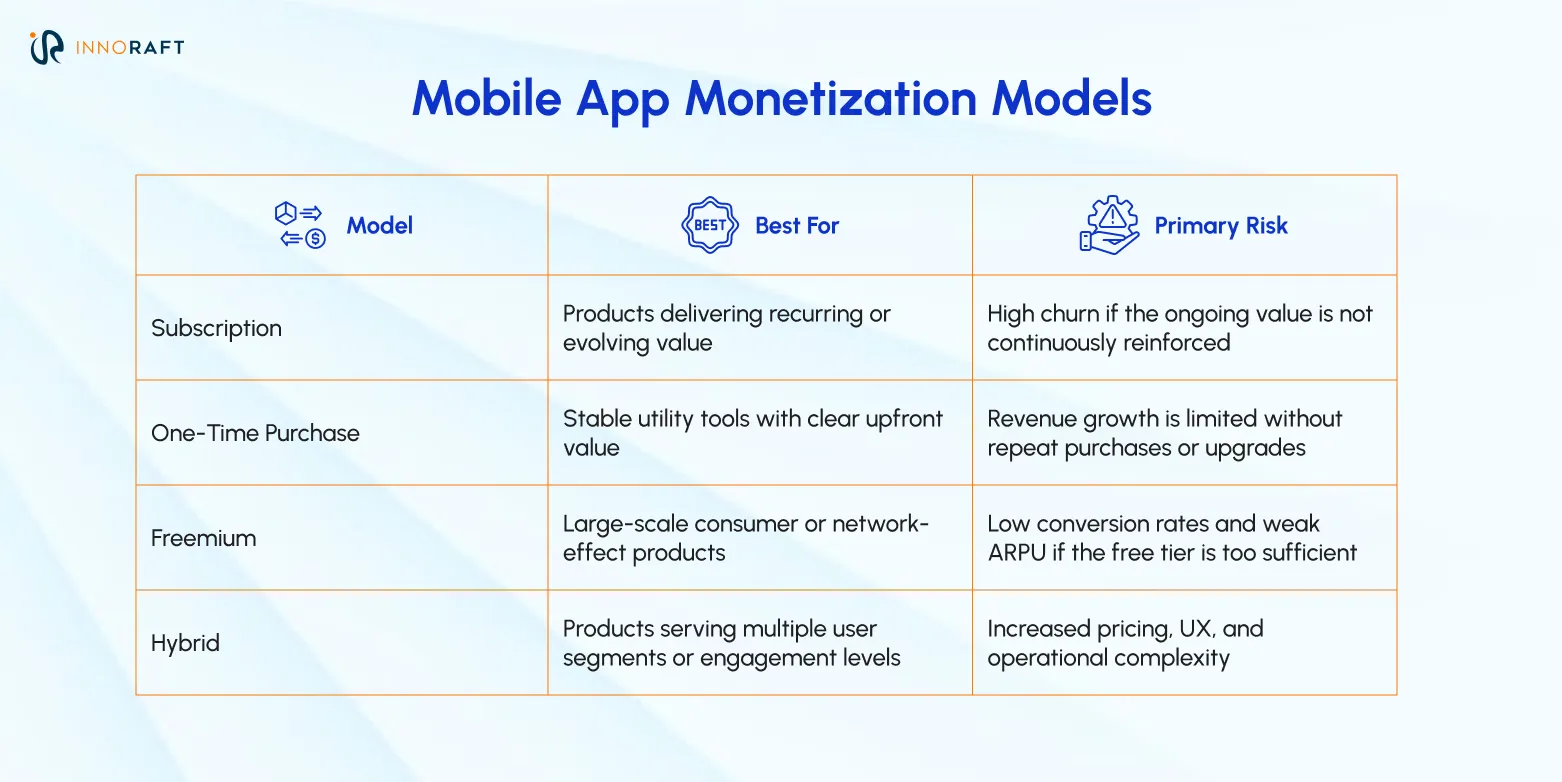
Industry benchmarks from RevenueCat's State of Subscription Apps 2026 show hard paywalls convert at roughly five times the rate of freemium in productivity and health categories, but not universally. Social apps still need free user volume to make the product valuable for paid users. Match the model to the loop, not to a default.
Industry benchmarks from AppsFlyer and UXCam put average 30-day retention across all categories at roughly 6%. Acquiring a new user to replace a churned one costs significantly more than keeping the original. Retention isn't a growth strategy, it's the foundation growth sits on.
Section 7: How Do High-Performing Teams Actually Ship in 2026?
Most release failures aren't code failures. They're process failures; no gradual rollout, no kill switch, no way to catch a bad deployment before it hits everyone. CI/CD, feature flags, and staged rollouts (1% → 10% → 100%) exist specifically for that. As for the use of AI in mobile app development, well, they can be useful, but the Stack Overflow 2025 survey puts the actual acceptance rate of AI-generated code at 30%. The other 70% gets rewritten or thrown out. Speed gains are real. So is the review overhead- teams that skip adjusting their review processes rarely save the time they expect.
Real-device testing is non-negotiable. Emulators don't replicate battery drain, thermal throttling, or real-world network degradation. Crash analytics and Real User Monitoring (RUM) catch what the lab misses, and in mobile, the gap between lab and field is almost always larger than teams expect.
Key takeaway: Velocity without observability is just moving faster toward the wrong thing.
Section 8: What Emerging Technologies are Worth Watching?
Most teams overestimate near-term impact and underestimate long-term shifts in mobile app development trends 2026. That pattern has held for 5G, AR, and now AI.
- 5G: Design for degraded performance, not peak conditions. Most users hit mixed networks, background throttling, and battery constraints in daily use. Build for those first.
- XR and Spatial Computing: Focus on Proven ROI: Extended reality has moved beyond experimentation in a few specific industries, but adoption remains uneven across consumer markets.
| XR Use Case | Status | ROI Signal |
| Retail virtual try-on | Production, proven | Measurable conversion uplift |
| Industrial/medical training | Production, proven | Quantifiable cost reduction |
| General consumer AR | Early, fragmented | Limited by device reach |
| Spatial computing | Early, niche | High cost, small market in 2026 |
The strongest opportunities today are still workflow-driven, not entertainment-driven. Teams seeing success with XR are solving expensive operational problems, not chasing novelty.
- For foldables, wearables, and ambient computing: design for adaptability and continuity; state preserved across device transitions. Fix one bottleneck at a time. A mediocre experience everywhere beats an excellent one nowhere.
Conclusion: What Should Be Your Approach for Mobile App Development in 2026?
Don’t aim for flashy tech or horizon-breaking UI/UX design. Aim for usability. The future of mobile applications belongs to those apps that deliver usefulness faster than any alternative on the user’s phone.
The winning app in 2026 is fast to value, reliable under real conditions, secure by design, and improving based on real signals, not internal assumptions. The teams behind them don't win on tools. They win on execution, prioritization, and genuine user understanding.
The teams that win won't be using the latest Mobile app development technologies and tools; they'll be using the right strategy and tech stack in the right order. That is why you must start with a focused audit, not a full rebuild. Answer three questions:
- How long does it take a new user to experience real value?
- What specifically causes your Day 7 retention drop?
- Where is your biggest session drop-off — and what would closing it actually require?
Ready to build your mobile app? Contact our experts today!
FAQ
Frequently Asked Questions
Didn’t find what you were looking for here?